



Page content
X-ray diffraction (XRD) is a powerful analytical technique used to study the structure, composition, and physical properties of crystalline materials. This non-destructive method relies on the interaction between X-rays and the atoms in a crystal lattice, producing a unique diffraction pattern that serves as a "fingerprint" for the material being analysed. By measuring these diffraction patterns, researchers can determine various characteristics of the sample, including its chemical composition, crystal structure, crystallite size, and lattice parameters.
Uses & Capabilities
This type of equipment could be used for:
- XRD is extensively used in industrial settings for process control and quality assurance. It plays a crucial role in industries such as mining, cement production, and building materials manufacturing.
- XRD is an essential tool for studying drug formulations and polymorphism. It helps in identifying different crystal structures of drug compounds, which can significantly affect their solubility, bioavailability, and stability during drug development, formulation, and quality control phases.
- XRD is widely employed in the semiconductor industry for analyzing crystal defects and inspecting thin-film layers in semiconductor materials. This is crucial for ensuring the quality and performance of electronic components and devices.
- XRD is used across various manufacturing sectors for materials crystallographic characterization. This information is vital for product development, troubleshooting manufacturing issues, and ensuring the quality of raw materials and finished products in industries such as automotive, aerospace, and battery manufacturing.
Key Features
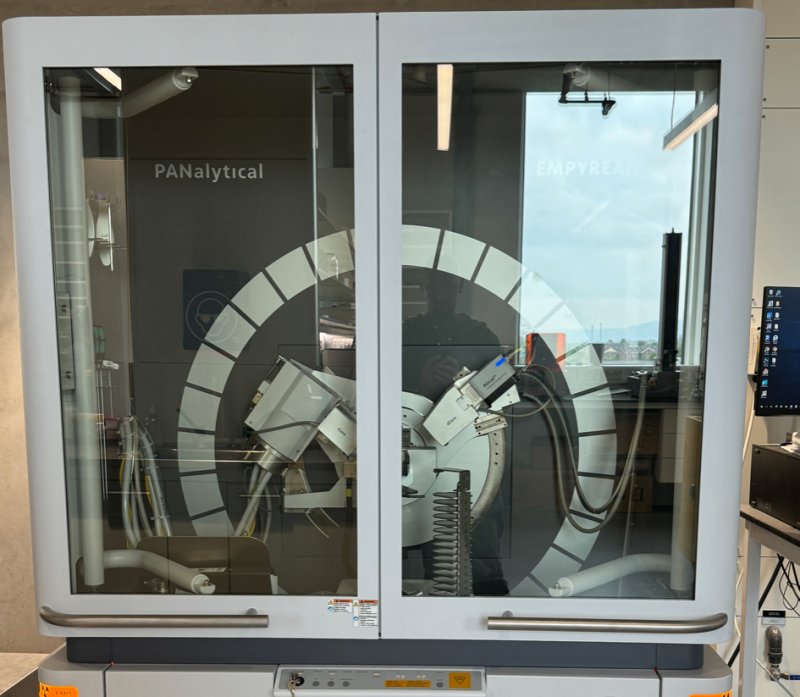
The PANalytical Empyrean X-ray Diffractometer is a versatile, multipurpose research instrument designed for non-destructive materials investigation. The Empyrean system features a unique combination of sample stages and optical components, allowing for easy reconfiguration and adaptation. Its advanced capabilities include superior resolution, high dynamic range, and the ability to perform small- and wide-angle X-ray scattering (SAXS/WAXS) measurements, making it an ideal tool for modern materials research and industrial applications.
- Versatility: The Empyrean is a true multipurpose platform capable of analyzing powders, thin films, nanomaterials, and solid objects without compromising data quality
- Measurement Capabilities: Powders, Thin Films, Nanomaterials, Solid Objects: Suitable for a wide range of sample types, SAXS/WAXS: Small- and wide-angle X-ray scattering for nanostructure analysis
- Specialist options for: Non-ambient Analysis, In-operando Analysis, Computed Tomography (CT), 2D XRD, Pair Distribution Function etc
- Software and Automation: HighScore Package for automated analysis, Batch Processing etc
Specifications
- MultiCore Optics: This innovative system allows for automatic switching between configurations without manual intervention or pausing the instrument, enabling fully automated multipurpose diffraction.
- PreFIX modules: These pre-aligned fast interchangeable X-ray modules allow quick switching between applications without the need for realignment.
- GaliPIX3D detector: This advanced detector can function as a point, line, and area detector, offering superior resolution, high dynamic range, and high count rate linearity.
- X-ray source flexibility: The system can use various X-ray tubes, from softer (Cu source, 8.04 keV) to medium (Mo source, 17.44 keV) up to hard (Ag source, 22.10 keV) radiations.
- Wide angular range: The goniometer offers a maximum usable range of -111° to 168°2theta, with a smallest addressable increment of 0.0001°.
- High-energy capabilities: Supports 60 kV excitation, enabling the use of high-intensity 22.16 keV Ag radiation for analyzing thick samples.
- In-operando analysis: Specialized holders and cells allow for real-time analysis of finished devices such as battery materials during charge-discharge cycling.
- Non-ambient conditions: The system supports heating and cooling of samples for temperature-dependent studies.
- SAXS/WAXS capabilities: Ability to perform small- and wide-angle X-ray scattering measurements for nanostructure analysis.