Crafting the Future: The Hybridisation of Digital and Traditional Costume Practices as a Model for Heritage-Informed Innovation in the Screen Industry
Apply and key information
This project is funded by:
- Department for the Economy (DfE)
Summary
Northern Ireland has a heritage in fashion manufacturing. To date, the industry has been constrained by lack of innovation and late adoption of technology (Harris et al 2024).
The regional contraction of fashion manufacturing (McDowell 2019) presents an opportunity for the industry to explore digital fashion and its potential for sustainable growth. NI screen industries have positioned NI as a prime TV/movie location, revitalising its creative economy.
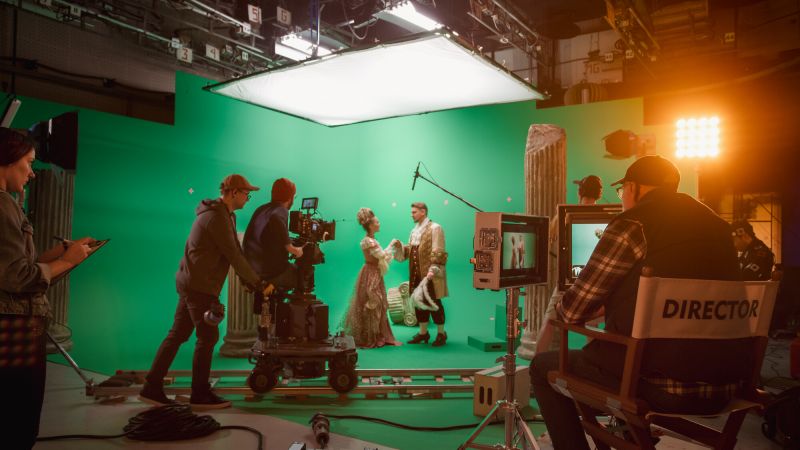
Costume design is inextricably linked to filmmaking and the nexus meshing fashion-design, heritage-craft, digital, phygital and virtual is under-explored.
As the fashion industry pivots to a digital future the gap between traditional practice and technology widens.
Costume is omnipresent on screen, however designers invisibility and the marginalisation of their creative practice undervalues their significance, yet the industry would be "Naked without us" (Youngs, 2021).
Physical garments remain valuable assets, retaining subtle nuances of materiality associated with tangibility; however virtual costumes enable dazzling, augmented effects beyond what is possible in the physical realm.
Increasing capability of digital technology means some physical costumes may be replaced with virtual ones (Kalmakurki, 2024).
Critical theoretical examination on designing costumes digitally and creating garments for the virtual world is sparse (Pantouvaki, 2024).
Little is known locally about the costume-design community. Their practices are rooted in craft-based heritage, and perceptions around digital tools are met with curiosity, resistance, and concern about loss of artistry.
This interdisciplinary research across fashion, screen and animation proposes a practice-based investigation to
(i)-capture current realities of the local costume-design community;
(ii)-explore if extending traditional approaches into hybrid, digital or virtual contexts might redefine designers’ heritage skills;
(iii)-reveal designers’ attitudes towards technology in relation to sustainability, values, acceptance, constraints and future trajectories;
(iv)-understand if digital fashion skills can lead to new employment pipelines and make befittingly rewarded contributions to the NI film and animation industry.
Essential criteria
Applicants should hold, or expect to obtain, a First or Upper Second Class Honours Degree in a subject relevant to the proposed area of study.
We may also consider applications from those who hold equivalent qualifications, for example, a Lower Second Class Honours Degree plus a Master’s Degree with Distinction.
In exceptional circumstances, the University may consider a portfolio of evidence from applicants who have appropriate professional experience which is equivalent to the learning outcomes of an Honours degree in lieu of academic qualifications.
- A comprehensive and articulate personal statement
- Research proposal of 2000 words detailing aims, objectives, milestones and methodology of the project
Desirable Criteria
If the University receives a large number of applicants for the project, the following desirable criteria may be applied to shortlist applicants for interview.
- Completion of Masters at a level equivalent to commendation or distinction at Ulster
- Practice-based research experience and/or dissemination
- Experience using research methods or other approaches relevant to the subject domain
- Work experience relevant to the proposed project
Equal Opportunities
The University is an equal opportunities employer and welcomes applicants from all sections of the community, particularly from those with disabilities.
Appointment will be made on merit.
Funding and eligibility
This project is funded by:
- Department for the Economy (DfE)
This scholarship will cover tuition fees and provide a maintenance allowance of £21,000* (tbc) per annum for three years (subject to satisfactory academic performance). A Research Training Support Grant (RTSG) of approximately £900 per annum is also available.
To be eligible for these scholarships, applicants must meet the following criteria:
- Have pre-settled status, or
- Have indefinite leave to remain or enter, or
Applicants should also meet the residency criteria which requires that they have lived in the EEA, Switzerland, the UK or Gibraltar for at least the three years preceding the start date of the research degree programme.
Applicants who already hold a doctoral degree or who have been registered on a programme of research leading to the award of a doctoral degree on a full-time basis for more than one year (or part-time equivalent) are NOT eligible to apply for an award.
Due consideration should be given to financing your studies.
*Part time PhD scholarships may be available, based on 0.5 of the full time rate, and will require a six year registration period
Recommended reading
McDowell, L., 2019. The last cut is the deepest - closure of shirt maker marks end of an era. Belfast Telegraph. 24 May 2019. Available at: https://www.belfasttelegraph.co.uk/opinion/columnists/lindy-mcdowell/lindy-mcdowell-the-last-cut-is-the-deepest-closure-of-shirt-maker-marks-end-of-an-era/38142891.html
Harris, J., Begum, L. and Vecchi, A., 2021. Business of fashion, textiles & technology: Mapping the UK fashion, textiles and technology ecosystem. Available at: https://ualresearchonline.arts.ac.uk/id/eprint/17172/1/BFTT_Mapping-the-UK-Fashion-Textiles-and-Technology-Ecosystem_2021.pdf [Last accessed 18 September 2025].
Youngs, I., 2021. Designer Jenny Beavan speaks out on 'extraordinary' Hollywood gender pay gap. 20 October 2022. Available at: https://www.bbc.co.uk/news/entertainment-arts-63305444 [Last accessed 18 September 2025].
Kalmakurki, M. (2024). Crafted for the Digital World: Digitally Realistic Costumes in CG Feature Films. Imagining the Impossible / International Journal for the Fantastic in Contemporary Media. DOI: 10.7146/imaginingtheimpossible.145367
Pantouvaki, S., 2024. Transmedia Costume as' Sustainable'Costume? Blending Physical and Virtual Bodily Materialities. International Journal of Film and Media Arts, 9(1), pp.32-46. DOI: 10.60543/ijfma.v9i1.9335
Additional Reading
Choi, K.H., 2022. 3D dynamic fashion design development using digital technology and its potential in online platforms. Fashion and Textiles, 9(1), p.9. DOI 10.1186/s40691-021-00286-1
Panagou, M., Kamtsis, N. and Gourgoulianni, S., 2021. The impact of new technologies on theater and costume. Int. J. Sci. Acad. Res, 2, pp.3122-3130. No DOI available
The Doctoral College at Ulster University



 Ulster Homepage