


A new immersive digital experience is helping to bring Northern Ireland’s maritime heritage to life – with the launch of the Maritime Trail app.
The Maritime Trail app is helping tourists and communities discover Northern Ireland’s rich heritage, promising new ways for museums to preserve their collections and showcase them to a wider audience.
Developed through funding from the Arts and Humanities Research Council (AHRC)’s follow‑on funding scheme, the app uses cutting‑edge 3D scanning and storytelling to make fragile museum collections accessible to the public in entirely new ways.
The project is led by Professor Maxim Fomin, alongside Professor Séamus Mac Mathúna, in partnership with the Ulster Transport Museum. Professor Fomin’s leadership has been central to shaping the project’s vision, ensuring that academic research, cultural heritage, and digital creativity come together in a meaningful and accessible way.
Professor Fomin has worked closely with Brian Coyle and Dr Michael McKnight, whose technical and research expertise helped bring the app from concept to reality.
The app connects detailed 3D models of six historic fishing vessels from the Ulster Transport Museum with coastal locations, folklore and audio narratives, offering an enriched understanding of our region’s maritime past.
The free app digitally links five scanned vessels to six locations across Northern Ireland and Donegal – Portbradden, Rathlin Island, Gola Island, Bunbeg, Lough Erne and Lough Neagh. These sites reflect the boats’ origins and are enhanced with audio content from museum archives, including interviews, music and storytelling.
The project brings together academics, curators, tech experts, and game design students to create a free, immersive experience for museum visitors, local citizens, and international tourists. The app allows users to explore National Museums Northern Ireland (NMNI) collections in their natural coastal contexts, enriching understanding and accessibility.
The Maritime Trail app was launched in 2025 with events across Northern Ireland, including a showcase at the Ulster Transport Museum, and has already reached national and international audiences through delivering talks about the project’s results in Durham, Prague, Bonn and New Delhi, highlighting the project’s global relevance.
The app is already supporting regional tourism, enhancing learning, and demonstrating how digital tools can help museums preserve and share collections that are too delicate for regular display. By placing heritage objects back into their natural coastal contexts, the experience deepens public engagement and opens up new possibilities for digital heritage interpretation.
Also being available in Irish and French has helped to make the app more accessible to tourists. Plans to create a Mandarin version are being explored supporting educational use in the 160 schools in Northern Ireland that teach Mandarin. Teachers are already integrating the app into their lessons as a dynamic learning tool.
Partnerships with universities in Scotland and Wales are also helping to expand the app’s content, incorporating additional boats and maritime data to deepen its cultural value across the UK.
Backed by Invest NI, the project team is now exploring a startup service that would help museums digitise their collections and connect with audiences in new ways. This will help expand the project’s long term commercial potential. By addressing limited access to fragile stored collections, the app supports regional tourism and offers a scalable model for digital heritage .
Professor Maxim Fomin, Professor of Celtic Studies, Digital Humanities & Irish Folklore, explains:
“Our work on the Maritime Trail project shows how digital innovation, when grounded in thoughtful research and genuine collaboration, can support heritage learning and tourism, benefitting both the research community and local populations.
The project brought together a truly interdisciplinary team, and seeing it presented at a major international education conference in Prague was a proud moment that highlighted what we can achieve when we work collectively across disciplines and institutions."
Find out more
You can read more about the Maritime Trail app at Digital maritime trail revives heritage and boosts local tourism – UKRI.
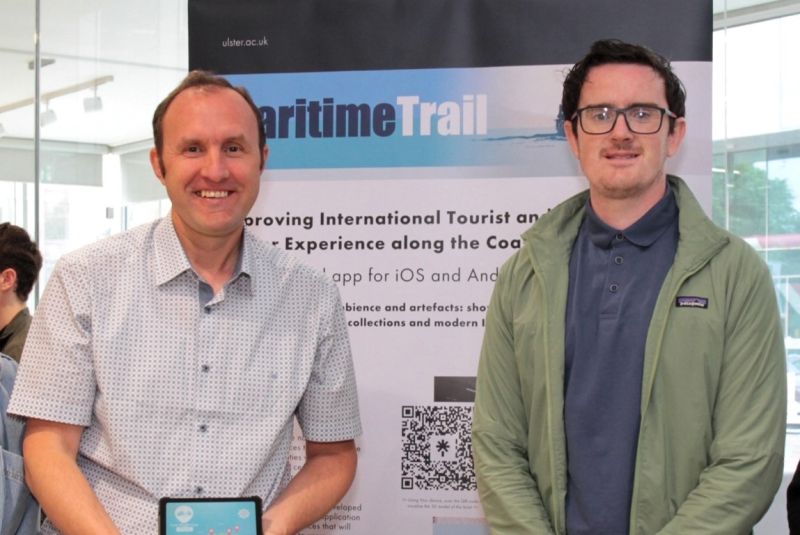
Top photo caption: Professor Maxim Fomin is photographed with Dr Pádraig Ó Tiarnaigh, former PhD researcher on the Stories of the Sea project, the forerunner of the Maritime Trail app project. The photo was taken during the launch of the project at Ulster University Research Week 2025, held on the Belfast campus.