


After two years of co-design research with Rathlin Island, Northern Ireland’s only inhabited offshore island, the Future Island-Island project is stepping into its second phase with renewed funding and ambition.
Led by Ulster University, in collaboration with Queen's University Belfast, The Glasgow School of Art, and University of the Arts London, the project will continue to work with the community and project partners to explore how island-led innovation can inform greener futures locally and globally.
Professor Justin Magee, Director, Future Island-Island; Research Director, Belfast School of Art, said:
“We are delighted to have secured extension funding as we continue to lead this important design-led research into phase two. Here, we deepen our commitment and relationship with the community of Rathlin while connecting new coastal and island communities across Irish, Scottish and Nordic locations.”
As one of four UK Green Transition Ecosystems, funded through the AHRC’s Future Observatory: Design the Green Transition programme, the project has combined design thinking with community insight to add value to waste, preserve heritage through digital technologies, develop new materials, and reimagine approaches to education and policy-making.
From Ideas to Action
Since September 2023, Future Island-Island has worked with the Rathlin community to turn ideas into action, connecting island life with broader systems of change. Through workshops and insight sessions, residents have shaped priorities, shared knowledge of local ecosystems, and guided real-world applications.
David Quinney Mee, Community Worker, Rathlin Development Community Association, added:
“The first two years with FII have been an insightful experience for all involved, marked by opportunities, challenges, and valuable learnings. Many residents have explored their passions with support and resources that would otherwise not have been available, and we welcome the extension as a chance to turn these early experiences into tangible community assets and inspire wider interest.”
Projects have included a systematic ocean stewardship approach to beach cleaning, converting beach plastics into 3D-printed prototypes, reawakening oral histories through local storytelling, and creating immersive XR tourism and heritage experiences. Education programmes have engaged all ages with their environment, over sixty funded fellowships have engaged the public more widely, and the pioneering Rathlin Citizens Panel has developed community-led net zero ferry recommendations.
One aspect of the project includes the revitalisation of Rathlin wool, where local knowledge and creative practice transform a traditional industry into a regenerative ecosystem.
Farm to Fibre: Rathlin Wool
Wool has long been part of Rathlin’s heritage. Once central to rural economies, it had been relegated to a low-value by-product, with farmers struggling to cover even the cost of shearing. Through a co-design process, the local community and farmers worked alongside textile artists and researchers Alison Gault and Anna Duffy (Future Island-Island; Belfast School of Art) to rethink wool on Rathlin as part of a traceable, circular economy.
Marina McLaughlin, Chair, Rathlin Development Community Association, shared:
“My family have been producing wool for generations. In the past, once the wool left the island, that was the end of our role. Now, it comes full circle, returning to Rathlin Island, reviving traditional skills and supporting local wool markets.”
Starting with sheep shearing on the island, fleeces are transported to the mainland for sorting and grading with Ulster Wool, then scoured and spun by Donegal Yarns. Raw fibres are transformed into yarn, rope, fabrics, and unique crafts. By developing new systems for processing waste wool, the community is connecting heritage, skills and innovation to unlock wool’s potential as a renewable resource – supporting a place-based creative economy.
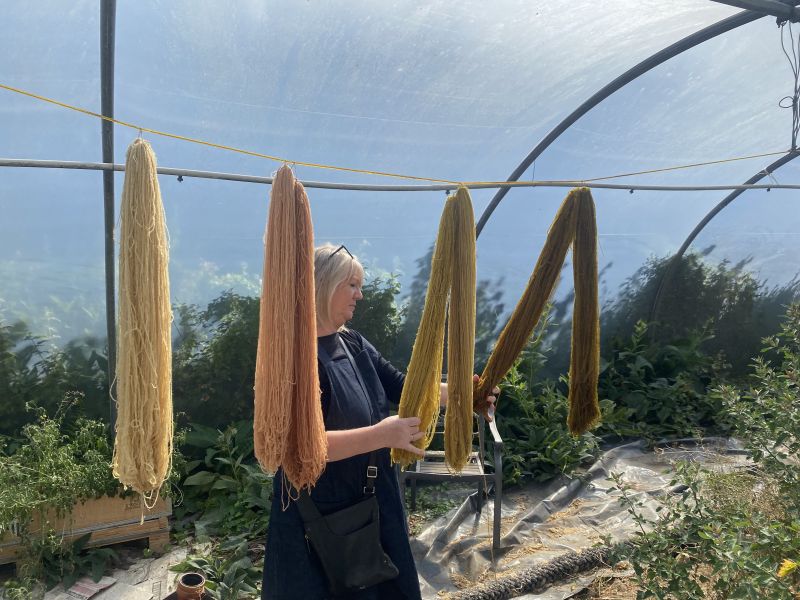
The Rathlin Wool Hub initiative has experimented with natural dyeing to create a Rathlin-inspired colour archive, prototyped biodegradable ropes to address marine microplastic pollution and support local kelp farming and crafted Rathlin Aran and Fair Isle knitwear designs.
Fellowships have also enabled the local Hooked on Rathlin knitwear business to develop designs using 100% island wool, as well as the creation of the illustrated book, ‘The Story of Rathlin Wool’, which traces the fleece from farm to marketplace.
Looking Ahead: Phase Two
As Phase One concludes, Future Island-Island is showcased at the Design Museum, London, as part of the Future Observatory’s ‘Tools for Transition’ exhibition. It marks a moment to celebrate two years of collaboration with Rathlin Island and collaborative partners, and to thank the community for its curiosity, critical thought and imagination in co-designing green transitions.
Spanning from 01 October 2025 to 31 March 2028, Phase Two, led by Project Director Professor Justin Magee (Ulster University) and Co-Director Dr Clare Mulholland (Queen’s University Belfast), will foster growth for applied circular innovation.
Professor Christopher Smith, AHRC Executive Chair said:
“We are delighted that the Green Transition Ecosystems have been renewed for a second phase. Each project demonstrates the power of design in convening stakeholders across communities, sectors and disciplines to intervene in systemic green transition challenges. In their second phase, the GTEs focus on delivering outcomes for future sustainable growth”.
Professor Magee continued:
“Through the three key themes of circular materials, digital narratives and advancing Rathlin’s ‘East Light’ vision, we aim to explore the notion of waste-free islands and advance place-based socio-economic and knowledge economy opportunities in alignment with human and planet health.”
From Rathlin to Northern Ireland and beyond, Future Island-Island is turning design thinking and community collaboration into pathways for a greener, better tomorrow.