


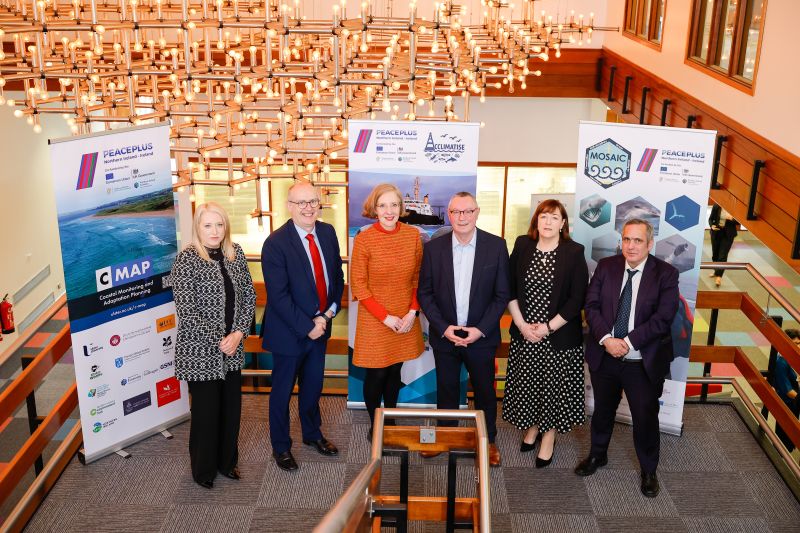
Ulster University celebrated the official launch of CMAP (Coastal Monitoring and Adaptation Planning), a flagship €9.6M project supported by PEACEPLUS, a programme managed by the Special EU Programmes Body (SEUPB).
The launch event, held at the Agri-Food and Biosciences Institute (AFBI) in Belfast, brought together academic leaders, government representatives, environmental organisations and community stakeholders to mark the beginning of this major cross-border collaboration.
The event also introduced two further PEACEPLUS-supported marine initiatives – ACCLIMATISE and MOSAIC – highlighting a shared commitment to protecting coastal environments through innovation, partnership and community action.
The CMAP project forms part of a new wave of coordinated cross-border marine initiatives marking a significant step-change in how coastal protection and climate adaptation are approached across the island of Ireland.
Coastal regions are facing increasing pressures from sea-level rise, stronger storm activity, erosion and biodiversity loss – challenges that demand coordinated, cross-border solutions and new ways of working. CMAP has been created to help communities, policymakers and environmental stakeholders better understand and respond to the growing impacts of climate change on the Irish coast.
This fully funded programme brings together a diverse partnership of organisations across Northern Ireland and the Republic of Ireland, combining scientific expertise, environmental knowledge and community engagement to address coastal restoration challenges. Partners include:
- Causeway Coast & Glens Heritage Trust
- National Trust
- Ulster Wildlife
- NI Environment Link
- University College Cork
- Trinity College Dublin
- RSPB
- University of Galway
- Geological Survey Northern Ireland (GSNI)
- Louth County Council
- Newry, Mourne and Down District Council
With climate adaptation now essential for environmental sustainability and long-term regional resilience, the initiative will deliver research, data and on-the-ground activities focused on coastal processes, habitat restoration and citizen science across 15 coastal sites in Counties Sligo, Donegal, Londonderry, Antrim, Down and Louth.
Speaking at the joint launch, Minister of Agriculture, Environment and Rural Affairs Andrew Muir MLA, said:
“I am delighted to mark the launch of three significant PEACEPLUS projects, supported by €25 million in funding, dedicated to strengthening the resilience of our shared marine waters. I wish to acknowledge the Special EU Programmes Body, whose leadership has created this valuable opportunity for joint learning and collaboration on the challenges facing our oceans.
“Climate change, biodiversity loss and water pollution are already affecting our ecosystems, our communities and our economy. The situation at Lough Neagh in recent summers is a clear reminder of the scale of the environmental challenge. Improving water quality is a central priority for me and this source‑to‑sea approach, will help deliver on our commitment in the Programme for Government to improve water quality.
“I am proud to support these projects, not only through the Department’s investment, but through our continued partnership with Special EU Programmes Body to provide strategic guidance on C-MAP, MOSAIC and ACCLIMATISE. I am particularly encouraged by the breadth of collaboration involved, with more than 30 partner organisations, bringing together leading scientific and environmental expertise across this island, Scotland and Canada. Through enhanced marine monitoring, shared evidence, habitat restoration and innovation, these projects will provide a robust evidence base, for forward-looking decision‑making and help build resilience of our marine environment for the years ahead.”
Timmy Dooley T.D, Minister of State at the Department of Climate, Energy and the Environment said:
"As Minister with responsibility for the Marine I am very supportive of projects which are aimed at the sustainable use of Ireland’s seas and coastlines. These three cross border projects, supported by the Department of Climate, Energy and the Environment, will dovetail with and enhance Ireland’s existing marine environmental framework, benefitting everyone on the island who uses or enjoys the sea.”
SEUPB Chief Executive Gina McIntyre said:
“Our natural environment is one of our greatest assets. Protecting and enhancing it is essential not only for biodiversity, but also for the health, prosperity and well-being of our communities. A clean, accessible and resilient coastline supports tourism, industry, recreation and quality of life – and it contributes to a peaceful, sustainable future for all.
"Today marks a significant milestone for the PEACEPLUS Programme and for the future of our shared marine and coastal environment. The investment in ACCLIMATISE, CMAP and MOSAIC shows what can be achieved when institutions, researchers, communities and governments work together with shared purpose.
Professor Derek Jackson, Lead Investigator on the CMAP project at Ulster University’s School of Geography and Environmental Sciences, said:
“CMAP represents a significant step forward in how we understand and respond to climate change impacts on our coasts. By combining scientific research with community engagement and cross-border collaboration, we can develop more appropriate strategies to address erosion, biodiversity loss and changing coastal dynamics.”
Professor Liam Maguire, Ulster University Pro Vice-Chancellor for Research and Impact, added:
“This award reflects our research excellence and track record in this area and resonates with our strategic focus on partnerships, place and sustainable futures for all.”
Working alongside ACCLIMATISE and MOSAIC under the PEACEPLUS Marine and Coastal Management programme, CMAP forms part of a wider cross-border effort to protect natural environments, support communities and promote a shared, sustainable future for coastal regions.