


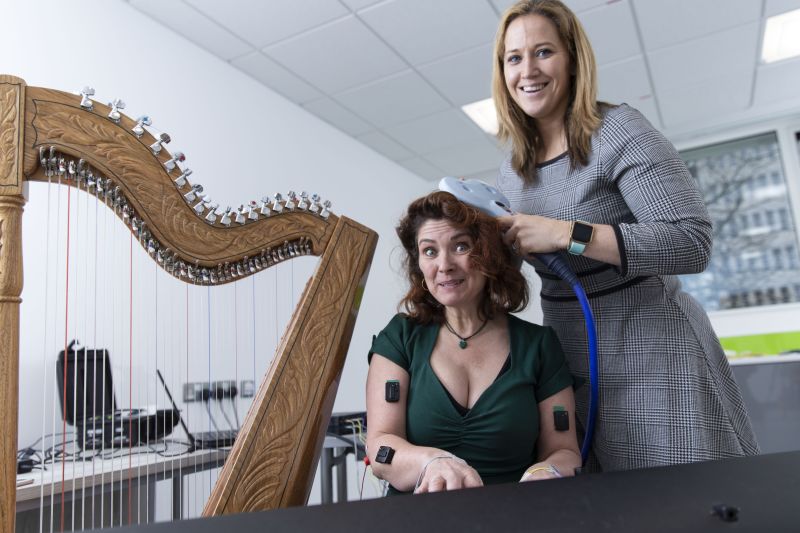
Ulster University researchers are advancing understanding of how the brain adapts, reorganises and recovers by studying the uniquely adapted brains of professional harpists.
The findings are providing new insights into neuroplasticity – the brain's ability to form, strengthen and reorganise neural connections throughout life – with important implications for future rehabilitation following stroke and brain injury.
Research brought to life at Fleadh Cheoil na hÉireann
As part of Fleadh Cheoil na hÉireann, the University will showcase this research through The Neuroscience of the Harper's Brain, featuring neuroscientist Dr Niamh Kennedy from Ulster University's School of Psychology and acclaimed Belfast harpist Ursula Burns.
Combining live music, storytelling and neuroscience, the event will illustrate how decades of expert musical performance reshape the brain and explain why those discoveries have significance far beyond music.
Delivered in partnership with the Northern Ireland Science Festival, the showcase forms part of Ulster University's contribution as a core host venue and educational partner for Fleadh Cheoil na hÉireann 2026.
Throughout the week, the University's Belfast campus will welcome thousands of musicians, students and visitors from across Ireland and around the world, providing a unique opportunity to showcase how Ulster University's research is advancing health, science, creativity and culture.
What the harpist's brain can teach us about stroke recovery
Dr Niamh Kennedy said:
"Musicians give us an extraordinary opportunity to understand what the human brain is capable of. Years of learning, practising and performing don't simply develop musical ability – they physically reshape the brain, creating highly sophisticated networks responsible for movement, coordination, memory, creativity and emotion.
"The harp is particularly fascinating because it demands an exceptional level of coordination and precision, with both hands performing completely different movements while constantly responding to rhythm, timing and expression. That makes the harpist's brain a powerful model for understanding how complex neural networks are built, strengthened and refined over time.
"What excites us most is that this research reaches far beyond music. By understanding how expert musicians' brains adapt and reorganise themselves, we can apply those insights to one of the biggest challenges in neuroscience – helping the brain recover after stroke and injury. Every new discovery strengthens our understanding of neuroplasticity and has the potential to inform future rehabilitation approaches that improve people's lives."
For Ursula Burns, participating in the research has offered a completely new perspective on a lifetime of music-making.
She said:
"As musicians, we spend years developing skills that eventually become second nature, so it has been fascinating to discover the science behind what is happening inside my brain every time I sit down to play.
"It's particularly special to share this research during the Fleadh, where people from across the world are coming together to celebrate Irish traditional music. To think that our national instrument can also contribute to research that may one day help people recovering from stroke and brain injury is both humbling and inspiring."
Music and science united through collaboration
Professor Liam Maguire, Pro Vice-Chancellor for Research at Ulster University, said:
"The most significant research often emerges where different disciplines come together to tackle complex challenges in new ways. By combining neuroscience with Ireland's rich musical heritage, our researchers are generating knowledge that has the potential to shape future approaches to neurological rehabilitation while deepening our understanding of the human brain.
"Fleadh Cheoil na hÉireann provides an exceptional opportunity to showcase Ulster University's internationally recognised research to audiences from across Ireland and around the world. It reflects our commitment to research excellence that is driving advances across health, science, creativity and culture, while delivering meaningful benefits for society through collaboration, innovation and cultural engagement."
Neuroscience of the Harper's Brain takes place at Black Box, Belfast, on Monday 3 Aug, at 2.30pm and 7.30pm.