


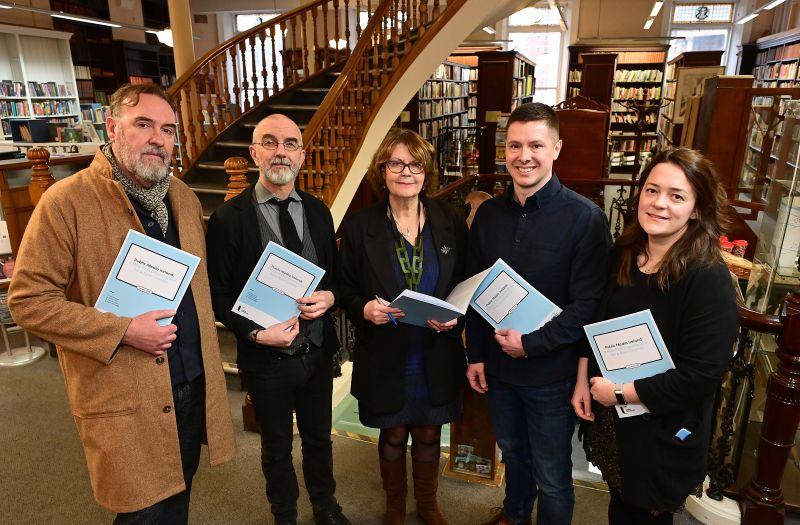
In a report launched today, researchers from Ulster University and Dublin City University have considered what might happen to Public Service Media in a reunified Ireland.
The report asks whether BBC Northern Ireland would continue to exist; if RTÉ would take over; or, if a new body should be set up. Setting out five options for what might happen, the authors conclude that a reunified Ireland should have a new Public Broadcaster, provisionally called Public Media Ireland.
The report – Public Media Ireland: a New PSM Organisation for a New Country – looks at ideas around journalism, funding and content, suggesting that there is much about the current broadcasters worth preserving. But it takes inspiration from the run up to the Scottish Independence referendum when a new Scottish Broadcasting Service was imagined, by setting out future-facing ideas.
The report acknowledges that “Irish reunification is not a foregone conclusion. It could take place in the medium term, the long term, or indeed not at all.”
It also argues that in the run up to a referendum on the issue, media is likely to come further down the list of priorities for discussion and planning, such as healthcare or taxation – but that whatever media system might emerge would play a crucial role in the shaping of the country.
The report sets out that:
- Establishing a new Public Service Media (PSM) organisation Public Media Ireland in a reunified Ireland should be considered, as relying on a private model or simply replicating the RTÉ/BBC funding structure would not work.
- Ten regional journalism hubs (e.g., Belfast, Derry, Galway, Dublin, Cork) should be created to deliver balanced news coverage and integrate creative and cultural content alongside journalism.
- A sustainable funding system inspired by Finland should be considered, where individuals and organisations contribute proportionally to income (capped), generating significant revenue for PSM.
- A future-facing media model that preserves valuable elements of current broadcasters should be designed, while ensuring diversity, decentralisation, and democratic accountability.
The report comes out of a research collaboration between Dr Phil Ramsey and Dr Stephen Baker (Ulster University), and Dr Roddy Flynn and Dr Dawn Wheatley (Dublin City University), who have worked on issues of media, journalism, and funding for many years. The launch event is being chaired by Susan McKay, Press Ombudsman for Ireland.
Report author, Dr Phil Ramsey from Ulster University, said:
“This report kickstarts a debate on what the future of media might look like across Ireland. This is the beginning of a conversation, and we want interested parties to have their say on the recommendations.”
Report author, Dr Dawn Wheatley from Dublin City University, said:
“It is impossible to say with certainly what might happen to public media should the reunification of Ireland ever occur. But in this report we suggest that public broadcasters play a vital role within democracies, and so they should not be overlooked in wider debates.”