Constructed, Virtual and Real-Time Integration of Artefact and Environments: Achieving Seamless Digital Spatial Registry in Cinematic Production.
Apply and key information
This project is funded by:
Summary
Continuous Digital Spatial Registry (CDSR) will be developed through theoretical and applied research supported by academic supervision from Ulster University Screen Academy, access to the industry-leading CoSTAR R&D network and collaboration with Poli Productions Ltd, award winning global innovators in emerging workflows & enhanced data capture.
The Challenge: Disconnected Cinematic Workflows
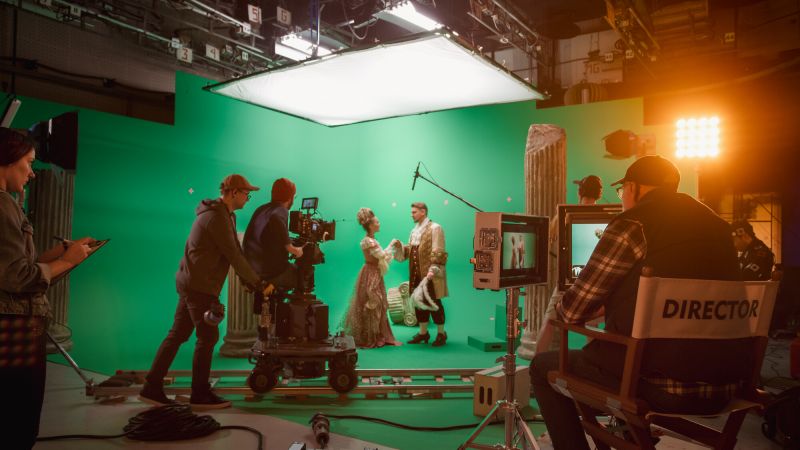
Cinematic production involves three disconnected landscapes:
- Physical reality (physical sets, cameras, actors),
- In-camera VFX (dynamic LED volumes/backdrops),
- Post-production VFX (digital extension and repair).
Typically spawned from the same initial digital footprint, these processes tend to drift apart. The original high-value digital assets are discarded or lose their digital regiment when physical elements (printed concept art, sets built from 2D drawings) are introduced, unlike VFX which largely remains digital.The disconnect contributes spatial registry issues. Post-production often has to erase and replace content created during physical/in-camera shooting because it doesn't seamlessly match, doubling the work and cost.
The core research imperative: Continuous Digital Spatial Registry CDSR to manufacture and capture "functional narrative landscapes" (physical sets, digital environments, LED volumes) within a unified digital process.
Applied and theoretical research will develop and test CDSR to ensure production processes remain optimally digital, adhere to consistent digital regiment and are spawned from the same digital source throughout. In CDSR all elements—physical or digital—will be precisely aligned and identifiable throughout pre-production, production, and post-production.
Integrating VFX from the outset by extracting extensive, real-time metadata during filming.
will contribute to a paradigm shift from traditional post-production as a "fix-it" stage.
Key data captured at the highest degree includes:
- Lens Calibration
- Tracking Systems
- Real-time Integration
- Data Aggregation
- The "Flip Switch" and Automated Matting
The research aims to empower post-production and the research will encompass quantifying impact on production efficiency.
For a more detail project description contact K.fleming@ulster.ac.uk including ‘PhD CDSR’ in subject line.
Desired skills of the applicant
Experience using virtual production technologies, VFX, AR, VR in a professional context and/ or screen industry experience is desirable.
Essential criteria
Applicants should hold, or expect to obtain, a First or Upper Second Class Honours Degree in a subject relevant to the proposed area of study.
We may also consider applications from those who hold equivalent qualifications, for example, a Lower Second Class Honours Degree plus a Master’s Degree with Distinction.
In exceptional circumstances, the University may consider a portfolio of evidence from applicants who have appropriate professional experience which is equivalent to the learning outcomes of an Honours degree in lieu of academic qualifications.
- Sound understanding of subject area as evidenced by a comprehensive research proposal
Desirable Criteria
If the University receives a large number of applicants for the project, the following desirable criteria may be applied to shortlist applicants for interview.
- Completion of Masters at a level equivalent to commendation or distinction at Ulster
- Experience using research methods or other approaches relevant to the subject domain
Equal Opportunities
The University is an equal opportunities employer and welcomes applicants from all sections of the community, particularly from those with disabilities.
Appointment will be made on merit.
Funding and eligibility
This project is funded by:
This scholarship will cover tuition fees and provide a maintenance allowance of £20,780 per annum for three years (subject to satisfactory academic performance). A Research Training Support Grant (RTSG) is also available. Fees and a maintenance stipend will also be provided for approved placements of up to six months.
To be eligible for these scholarships, applicants must meet the following criteria:
- Be a UK National, or
- Have settled status, or
- Have pre-settled status, or
- Have indefinite leave to remain or enter, or
- be an Irish National
Applicants should also meet the residency criteria which requires that they have lived in the EEA, Switzerland, the UK or Gibraltar for at least the three years preceding the start date of the research degree programme.
Applicants who already hold a doctoral degree or who have been registered on a programme of research leading to the award of a doctoral degree on a full-time basis for more than one year (or part-time equivalent) are NOT eligible to apply for an award.
Due consideration should be given to financing your studies.
Recommended reading
Autodesk (2023) A look at what 3D scanning means for the future of modeling. Autodesk Inventor Blog https://blogs.autodesk.com/inventor/look-3d-scanning-means-future-modeling/
Keeney, D. (2024) Virtual Production’s Role in Carbon Reduction and Net Zero Production in the Screen Industries Future Observatory Cultural Policy Fellowship Report. Future Observatory. DCMS UK
https://futureobservatory.org/files/dcmsreports/futureobservatory_culturalpolicyreport_studioulster.pdf
Ling C, Zhang W (2014) ARFMS: An AR-based WYSIWYG Filmmaking System. Indonesian Journal of Electrical Engineering Vol12 No 6 DOI: http://dx.doi.org/10.11591/telkomnika.v12i6.4582
Livingstone T. (2024) Hybrid Images and the Vanishing Point of Digital Visual Effects. Edinburgh University Press.
Patrucco, A. S., Marzi, G., & Trabucchi, D. (2023). The role of absorptive capacity and big data analytics in strategic purchasing and supply chain management decisions. Technovation, 126, 102814.https://doi.org/10.1016/j.technovation.2023.102814
Schindling, J., Gibbes, C. LiDAR as a tool for archaeological research: a case study. Archaeol Anthropol Sci 6, 411–423 (2014). https://doi.org/10.1007/s12520-014-0178-3
Samaras E (2021) Futureproofing Visual Effects. Challenges and Strategies for Preserving Digital Assets and Records. The international journal of Digital Curation. Vol 16 No. 1 DOI: https://doi.org/10.2218/ijdc.v16i1.689
Thorburn, D. and Jenkins H , eds. (2006) Rethinking Media Change: The Aesthetics of Transition. Cambridge, MA: MIT Press
Walker C. D. (2016) A Balancing Act — Practical Effects and Visual Effects. Medium https://medium.com/cinenation-show/a-balancing-act-practical-effects-and-visual-effects-96f29f26527a
Whicher A (2021) Evolution of policy Lsabs and use of Design for policy in UK Government. Policy Design and Practice 4(2), pp 252-270 . https://doi.org/10.1080/25741292.2021.1883834
BAFTA albert Consortium Sustainability (2020). BFI Bigger Picture Research. Green Matters – Environmental Sustainability and Film Production: an overview of current practice.
BFI/ARUP (2020). A Screen New Deal: A route map to sustainable film production Sustainability. BFI
Bozak, N., (2011). The cinematic footprint: Lights, camera, natural resources. Rutgers University Press.
The Doctoral College at Ulster University


 Ulster Homepage