


More than 400 Nursing and Paramedic Science students stepped into the heart of a dramatic, large-scale Community Resilience Disaster Day as part of their final year module designed to test their communication, critical decision making, leadership skills and their ability to work in fast-moving, high-pressure environments as part of a team.
Recognised as one of its kind on the island of Ireland and unique to Ulster University, the immersive training exercise is regarded as a Gold Standard educational experience for healthcare students to build resilience for future practice.
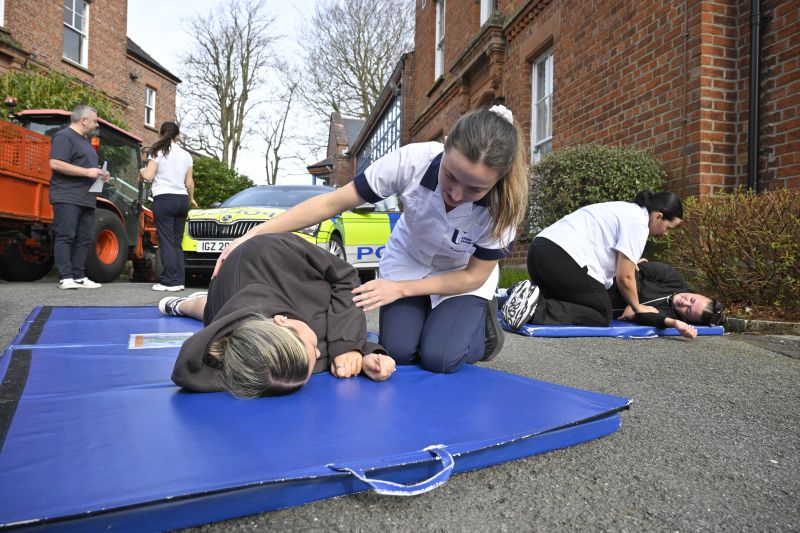
On campus grounds, students were supported in dealing with a simulated train disaster, road traffic collisions, and a major aircraft crash scenario mirroring the intensity of real frontline emergencies on the ground.
Students were required to assess, triage, and respond in real time, testing their clinical expertise, communication skills, and teamwork, adapting rapidly as situations evolved to make critical decisions under pressure.
The large-scale simulation brought together by Ulster University staff and a wide range of emergency service partners, including the Police Service of Northern Ireland, Northern Ireland Fire & Rescue Service, Northern Ireland Ambulance Service, Red Cross, alongside Emergency Department staff from the Belfast and Western Health and Social Care Trust.
Over 150 first and second year healthcare students acted as role players adding a layer of realism that heightened the intensity of the day. The result was a powerful, hands-on learning experience that pushed participants beyond the classroom and into the realities of emergency healthcare.
Neal Cook, Head of School of Nursing & Paramedic Science, School of Nursing and Paramedic Science said:
“This event is a highlight of our academic year, where our students learn and develop alongside vital agencies in our community through simulation and active learning strategies. It showcases the abilities of all involved, highlights the value of authentic, connected partnerships, and supports the development of our students to meet the challenging demands they will face in practice. The scale of the event and level of partnership reflect a shared commitment to the health of people in society.”
Third year student Beth Buchanan shared her thoughts on the experience, she said:
“The Community Resilience Disaster Day brought our learning to life in a way the classroom can’t. Taking part in such a large-scale exercise, responding to scenarios like road traffic collisions and major incidents, and working alongside emergency services including the ambulance service, fire and rescue, police, military personnel, voluntary organisations, and casualty actors — made it feel incredibly realistic and, at times, quite surreal.
It really pushed us to apply our clinical skills and decision-making, build resilience, carry out triage, communicate effectively, and stay calm under pressure. It’s been one of the most valuable experiences of my training, challenging us to think fast, work together, and respond under pressure, exactly what we’ll need as future nurses just months away from qualifying as registered practitioners.”
Linda McLaughlin, Emergency Response Officer for the Red Cross, a volunteer-led humanitarian charity, said:
“The Red Cross has been involved in the Community Resilience Disaster Day at Ulster University for over 10 years. We are delighted to participate in this important learning opportunity for students in a non-classroom setting and to provide an environment where they can consider the wide range of individual needs they may encounter within a Survivor Reception.”
The Next Generation of Emergency Professionals
If you see yourself working in the emergency services, Nursing, Paramedic Science or Medicine, Ulster University offers full-time and part-time study pathways to help you build a career that saves lives.
For more information, visit www.ulster.ac.uk/faculties/life-and-health-sciences/nursing-paramedic-science