




Student Satisfaction
National Student Survey (2026)

Elsewhere on Ulster


Our curriculum is based upon the research and scholarship of the team. In this Politics and International Studies with Criminology degree we foster your interests, ignite your passions and challenge and question the political and criminological world. We encourage students to pursue their interests, become research literate and have a strong understanding and appreciation of the research carried out in these disciplines. Students are encouraged to delve deep into politics and international studies and into criminology: to question, challenge and discover. You will develop expertise in key political and criminological concepts, theoretical ideas and research approaches. Focusing on political and criminal justice systems, you will critically examine the context in which it operates. This Politics and International Studies with Criminology degree provides a detailed knowledge and understanding of contemporary political analysis, an excellent training in social research methods, the ability to apply theoretical perspectives and concepts to real-life problems, and an appreciation of the complexity and diversity of political problems in society.
The degree equips graduates for employment in a range of careers in the statutory, voluntary and private sectors, locally and internationally. Our world leading research is used in the classroom to help develop the overall research literacy of the students. We give our students the opportunity to gain the skills and ability to carry out independent research, to assess the merits of competing theories and explanations, to work as part of a team, and to effectively engage in political debate with sensitivity to the views of others – all skills that are highly attractive to employers. Every student is encouraged to be an active member of the Politics and International Studies with Criminology team and pursue active learning in the academic study of the disciplines
Criminology forms the Minor component of this course. The Criminology component offers a range of ideas and theories from several different disciplines including law, public policy, social policy and economics. Students will examine mainstream concepts of criminology and criminal justice such as crime, environment, victims, desistance, sentencing, policing and emergent ideas on equality and human rights. These, coupled with knowledge of institutions and structures, will provide students with a wider understanding of behaviour and activity within the criminal justice system.
Discover Ulster University’s QS 5 Star ratings, a global mark of excellence recognising outstanding achievement across multiple categories.
QS Stars
We know that choosing to study at university is a big decision, and you may not always be able to find the information you need online.
Please contact Ulster University with any queries or questions you might have about:
For any queries regarding getting help with your application, please select Admissions in the drop down below.
For queries related to course content, including modules and placements, please select Course specific information.
We look forward to hearing from you.
QS Stars
Our Politics and International Studies with Criminology course covers all the core areas of the discipline and offers a range of options focusing on theories and ideologies and the study of the politics of international nations and organisations. It also includes the study of politics and political issues at the international level, as well as the study of themes such as the growing importance of 'identities' to political action. We have reviewed and revised the Course, introducing new modules including Populism, African Politics, Work Based Learning and Politics and the Politics of Deeply Divided Societies. Students will have an opportunity to cover the key areas of the discipline, including: the nature of power; the meaning and relevance of political ideologies; the interrelationships between domestic and international politics; the challenges posed by new social movements and global developments; the meaning and application of political theories. The course has been commended in internal and external review for its well-structured and relevant curriculum, which is underpinned by the original research and scholarship undertaken by staff teaching on the course. Our research has a well-established record of impressive achievements through:- first, the authorship of books and articles of acknowledged international excellence, second, demonstrable practical impacts on the policy-making process, and, third, winning against strong competition the support of prestigious sources of external funding including the Economic and Social Research Council, the Leverhulme Trust and the British Academy. Our research influences our teaching through the content of the curriculum, and through developing research awareness and literacy among our students. This is crucial since it helps students understand that research and scholarship is the basis of their university experience – other people’s research and their own research collectively make up the scholarship which defines a university. Additionally, our students gain the skills and ability to carry out independent research, to assess the merits of competing theories and explanations, to work as part of a team, and to effectively engage in policy debate with sensitivity to the views of others – all skills that are highly attractive to employers. Members of the team are actively engaged in research and scholarship, and in addition have collaborated with colleagues in the UK and Irish Political Studies Association to develop appropriate and innovative methodologies for developing students' independent learning capacities.
Diploma in Professional Practice DPP
Diploma in International Academic Studies DIAS
Full time programme. Each module usually involves a two hour lecture plus a one hour seminar each week. In addition, students are required to undertake substantial directed independent learning.
Instruction will take place in the form of two hour lectures and one hour seminars, or a combined three hour lecture/seminar, given on a weekly basis. Full attendance is essential. A module outline is provided at the start of the semester indicating the topics and readings for each session. More detailed lesson plans are made available via our online learning environment, Blackboard, well in advance of each teaching day. Students must consult Blackboard on a regular basis to ensure that they have the most recent information on readings and tasks that they need to complete before the upcoming session. All our modules require a significant commitment from students who are expected to be familiar with required readings when coming to class. Lectures will address complex substantive, conceptual and technical details required to fulfil the module aims. Students are expected to actively engage in dialogue with lecturers about the issues under discussion by asking and answering questions throughout lecture presentations. Seminars will build on instruction and facilitate dialogue and critical examination. Student group work in seminars and participation in debates and role playing /practical exercises will be features of seminars. Students will be directed to read steadily and extensively throughout the period between teaching sessions in order to keep up with the course requirements and fully benefit from participation in the teaching sessions. Students will be expected to participate in, and contribute effectively to, group tasks during the semester. Independent learning forms a core feature of the Politics and International Studies with Criminology programme. It is reflected in the requirement that students undertake a significant amount of external research to fulfil their assignments. Academic staff will be available to support and encourage that endeavour throughout. The structure assumes that academic staff will encourage students in ascertaining students' preferred area of research; give general and specific guidance in the location of relevant research materials; support the development of ideas and research plans; and guide students to governmental and non-governmental sources of materials and information that are relevant to their assignment. Students will be encouraged to develop retrieval skills in relation to academic and governmental sources. All our modules are offered by blended learning. The aim of all assessments is to give students the opportunity to review, consolidate and reflect on their learning and to demonstrate the extent to which they have acquired knowledge, understanding and skills. Hence, several modes of assessment are employed in Politics modules. Formative assessment involves course-based assessment work and ordinarily, though not always, accounts for 50% of the total marks available. It will give staff and students an early indication of their performance while providing a foundation for the summative assessment that accounts for the remaining 50%. Assessment activities are diverse and can include case studies, presentations, online quizes, policy briefs, crime/conflict/country analyses, essays and examinations.
The content for each course is summarised on the relevant course page, along with an overview of the modules that make up the course.
Each course is approved by the University and meets the expectations of:

As part of your course induction, you will be provided with details of the organisation and management of the course, including attendance and assessment requirements - usually in the form of a timetable.
For full-time courses, the precise timetable for each semester is not confirmed until close to the start date and may be subject to some change in the early weeks as all courses settle into their planned patterns. For part-time courses which require attendance on particular days and times, an expectation of the days and periods of attendance will be included in the letter of offer. A course handbook is also made available.
Courses comprise modules for which the notional effort involved is indicated by its credit rating. Each credit point represents 10 hours of student effort. Undergraduate courses typically contain 10, 20, or 40 credit modules (more usually 20).
The normal study load expectation for an undergraduate full-time course of study in the standard academic year is 120 credit points. This amounts to around 36-42 hours of expected teaching and learning per week, inclusive of attendance requirements for lectures, seminars, tutorials, practical work, fieldwork or other scheduled classes, private study, and assessment. Teaching and learning activities will be in-person and/or online depending on the nature of the course. Part-time study load is the same as full-time pro-rata, with each credit point representing 10 hours of student effort.
Class contact times vary by course and type of module. Typically, for a module predominantly delivered through lectures you can expect at least 3 contact hours per week (lectures/seminars/tutorials). Laboratory classes often require a greater intensity of attendance in blocks. Some modules may combine lecture and laboratory. The precise model will depend on the course you apply for and may be subject to change from year to year for quality or enhancement reasons. Prospective students will be consulted about any significant changes.
Assessment methods vary and are defined explicitly in each module. Assessment can be a combination of examination and coursework but may also be only one of these methods. Assessment is designed to assess your achievement of the module’s stated learning outcomes. You can expect to receive timely feedback on all coursework assessments. This feedback may be issued individually and/or issued to the group, and you will be encouraged to act on this feedback for your own development.
Coursework can take many forms, for example: essay, report, seminar paper, test, presentation, dissertation, design, artefacts, portfolio, journal, group work. The precise form and combination of assessment will depend on the course you apply for and the module. Details will be made available in advance through induction, the course handbook, the module specification, the assessment timetable and the assessment brief. The details are subject to change from year to year for quality or enhancement reasons. You will be consulted about any significant changes.
Normally, a module will have 4 learning outcomes, and no more than 2 items of assessment. An item of assessment can comprise more than one task. The notional workload and the equivalence across types of assessment is standardised. The module pass mark for undergraduate courses is 40%.
The class of Honours awarded in Bachelor’s degrees is usually determined by calculation of an aggregate mark based on performance across the modules at Levels 5 and 6, (which correspond to the second and third year of full-time attendance).
Level 6 modules contribute 70% of the aggregate mark and Level 5 contributes 30% to the calculation of the class of the award. Classification of integrated Master’s degrees with Honours include a Level 7 component. The calculation in this case is: 50% Level 7, 30% Level 6, 20% Level 5. At least half the Level 5 modules must be studied at the University for Level 5 to be included in the calculation of the class.
All other qualifications have an overall grade determined by results in modules from the final level of study.
QS Stars
Delivering a city university experience, we are located within Belfast's Cathedral Quarter, the cultural centre of the city.
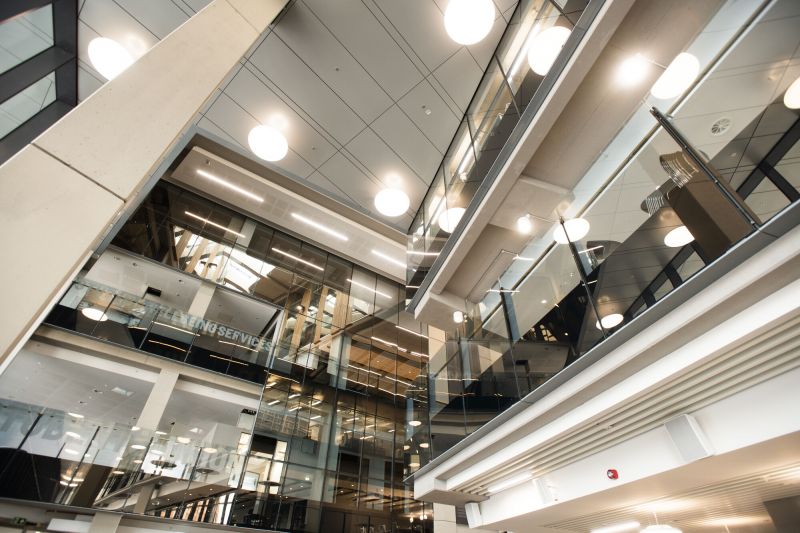
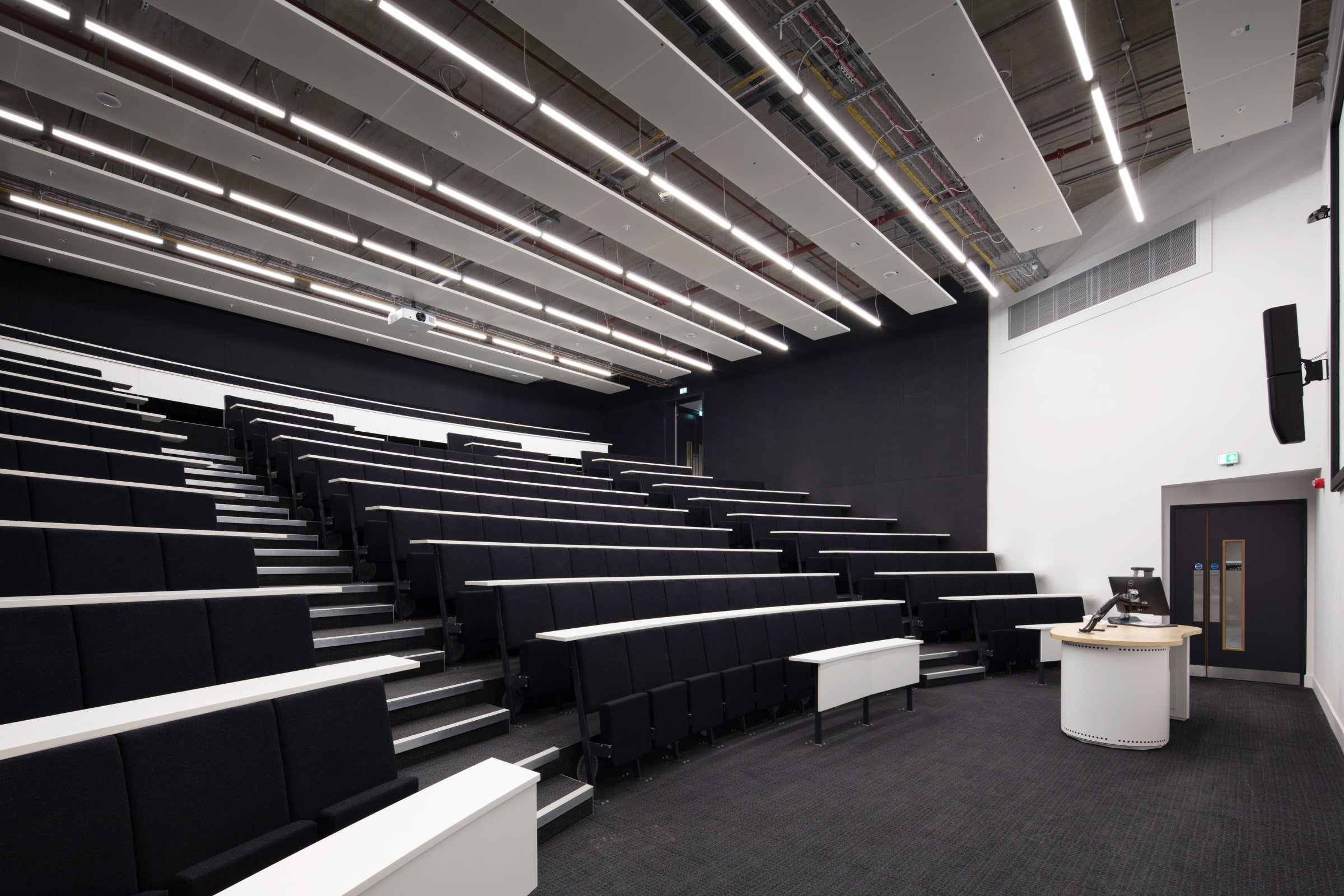
Explore the spaces, studios and social areas you'll use while studying at our Belfast campus. Prefer to explore at your own pace? Take the 360° virtual campus tour.
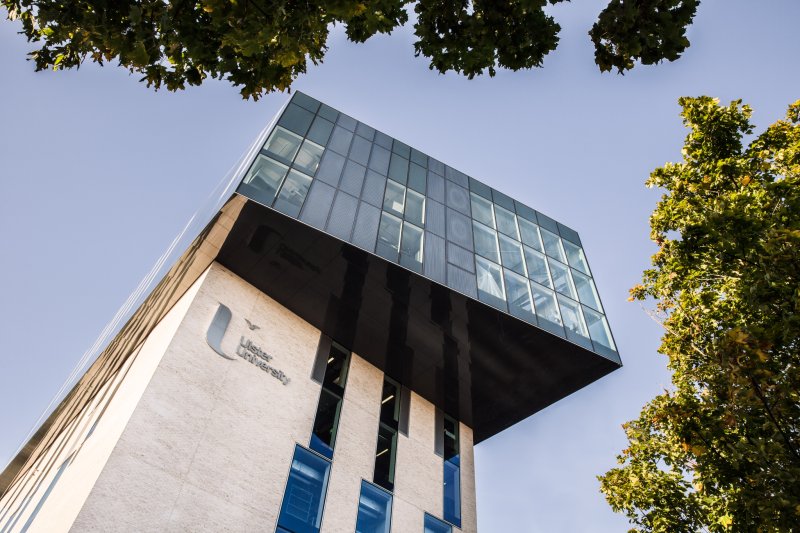


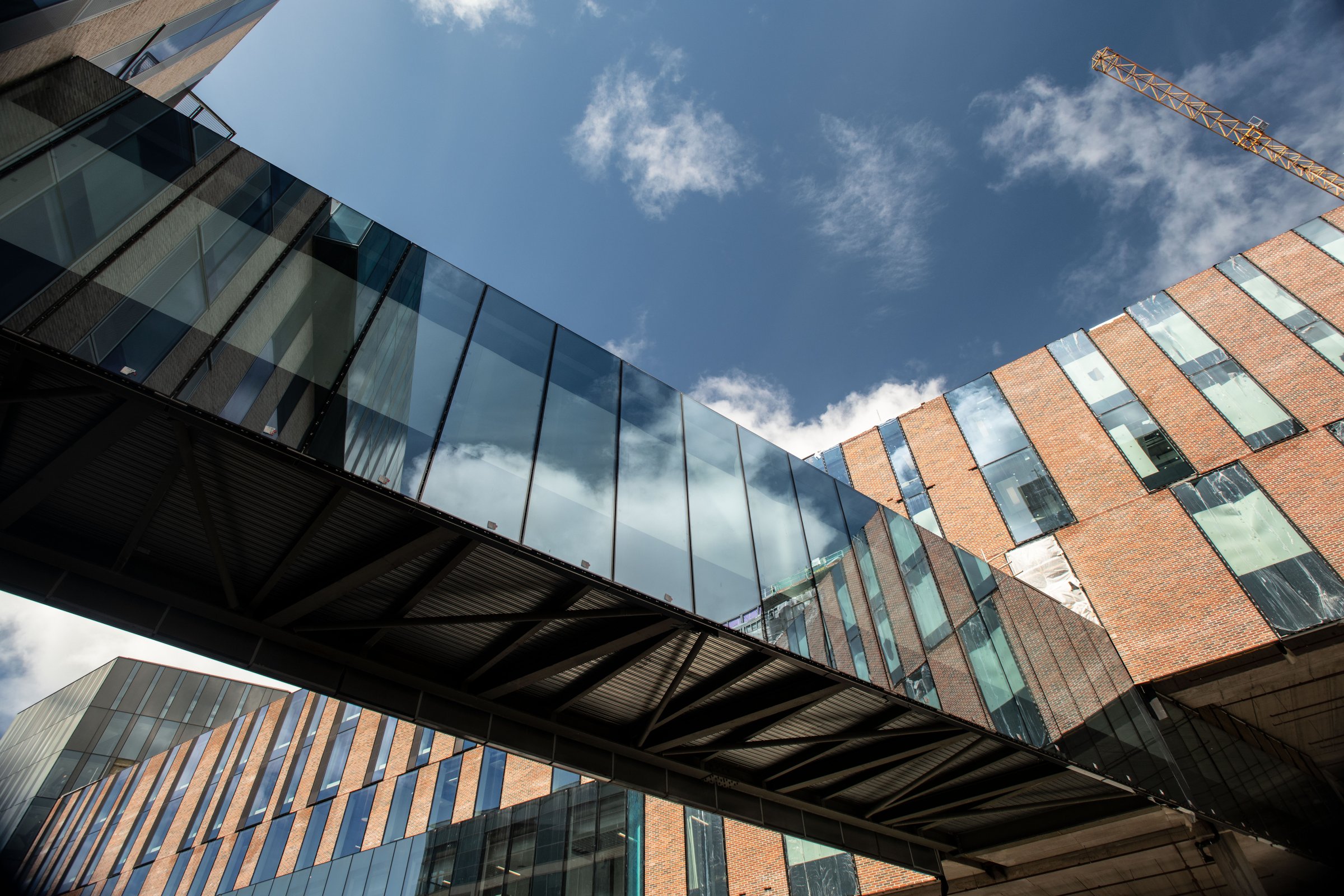
Belfast is a walkable city. Designed for sustainable travel, our Belfast location can be easily accessed from the surrounding neighbourhoods via foot, bike, public transportation, or road links to towns throughout Northern Ireland.
Belfast is home to a bustling social and cultural scene, both indoors and outdoors. Recognised with Purple Flag status for its safe, vibrant nightlife, Belfast offers an exciting mix of food, music and craic that attracts millions of visitors each year. Belfast's history, present and future is captured from each window of our state-of-the-art campus, with University sports facilities close by. Get a feel for student life beyond the campus on the Destination Belfast guide
Dive deeper into the places, services, virtual experiences and city life that will shape your student life in Belfast.
Here is a guide to the subjects studied on this course.
Courses are continually reviewed to take advantage of new teaching approaches and developments in research, industry and the professions. Please be aware that modules may change for your year of entry. The exact modules available and their order may vary depending on course updates, staff availability, timetabling and student demand. Please contact the course team for the most up to date module list.
Year: 1
Status: C
This module encourages students to look beneath the headlines and examine social constructions of crime. Ideas about 'crime', harm' and 'deviance' vary over time and place and the module explores popular discourses on these themes. The module introduces students to criminology as a discipline and to key theoretical traditions. The module provides a foundation of knowledge and skills for the criminology and criminal justice, and criminology minor degree programmes.
Year: 1
Status: C
This module will explore crime and its control through an analysis of the response of the criminal justice system, from the reporting/detection of incidents through the main criminal justice agencies and processes. Students will be introduced to the treatment and experiences of women, children, and victims and witnesses in the criminal justice system drawing upon national and international research.
Year: 1
Status: C
This module begins by assessing the meaning of politics, the relationship between politics and the state, and the role of government. Then, it describes the organisation of the state and its division of powers. Finally, an analysis is undertaken of the role of public administration in the formulation, implementation, and evaluation of public policy.
Year: 1
Status: C
This module introduces students to the study of political thought in its ideological forms. Political ideologies have been implicated in all major political developments over the last two centuries and demand special attention. This module clarifies the principles of these major systems, as well as critical ideological perspectives, and identifies their implications for political practice.
Year: 1
Status: C
This module introduces the student to the study of politics and international studies through the exploration of core study skills, concepts, approaches, and research strategies. It looks at the links between national and international politics and encourages students to think critically about social, political and economic trends. It provides the foundation for the critical analytical skills required in the study of politics, as well as core academic skills, and encourages collaboration and group work.
Status: O
Year: 1
This module is optional
The module is designed to provoke thought and stimulate questions about the nature of politics and government within the UK and Ireland. The module considers the key aspects of British and Irish politics including political culture, the function and structure of political parties and pressure groups, sub national forms of government and the role of the mass media. In doing so, it examines the dispersal of power within both the United Kingdom and the Republic of Ireland discusses the changing responsibilities of government, and the nature of political power in a modern state.
Status: O
Year: 1
This module is optional
Discover how global power, conflict, and cooperation shape the world we live in. This module mixes theory with real-world case studies on war, climate change, global inequality, and sustainable development to make sense of international politics. Explore the impact of states, international organisations, and non-state actors on today's biggest challenges. Build your skills in critical thinking, analysis, and evidence-based argument. By the end, you'll be ready to understand, debate, and engage with global issues confidently.
Year: 2
Status: C
This module considers the philosophical contributions of the major philosophers that have influenced political thought since the early enlightenment period and relates those contributions to the historical contexts in which they were written.
Year: 2
Status: C
This module looks at some of the most pertinent issues driving British politics in the 21st century - 'race', class, identity, media control, imperial legacies. It covers the "long durée" of the Empire and its aftermath into the contemporary era. Students are asked to engage with the ways in which British politics have been and continue to be shaped by such legacies as 'race' and class politics, and to consider policies that can promote diversity and inclusion.
Year: 2
Status: C
This module is designed to provide a work-based learning opportunity for students, allowing them to apply political scholarship to practical situations and link academic studies to the world outside the university. By practicing specific skills for employment - including the writing of CVs, giving presentations and critically reflecting on experience, the module aims to prepare students for the world of work after graduation.
Status: O
Year: 2
This module is optional
What purpose do the police serve in a democratic society? Are they simply 'citizens in uniform', or does the uniform embody a distinctive and potent form of authority? If it does, how is that authority enacted, justified, or abused—and with what consequences for society? How does the exercise of police power shape public trust, legitimacy, and social order? What role do non-state actors play in the broader landscape of policing, and how do these relationships vary across contexts? This module engages with Egon Bittner's enduring question: how can a society devoted to peace sustain an institution grounded in force?
Status: O
Year: 2
This module is optional
This module introduces students to the criminological study of environmental crime, harm and justice. Through inductive learning methods students will discover the common drivers of environmental crime. They will also learn about compliance, enforcement and justice mechanisms designed to combat environmental criminality.
Status: O
Year: 2
This module is optional
This module seeks to explore the definition and nature of state crime in criminological and political discourse. It aims to develop a critical understanding of the nature of the state and the scale and type of crimes committed by state agents and agencies. A range of state crimes will be explored in both the domestic and international spheres. The module will explore forms of state crime as techniques of 'coercive governance' and will use examples from both democratic and authoritarian regimes.
Status: O
Year: 2
This module is optional
This module further develops analytical skills in criminology and criminal justice. It evaluates, in the national and international context, the experiences, and the actual and potential role of victims of crime within the criminal justice system and explores criminal justice system responses to victims of crime.
Status: O
Year: 2
This module is optional
This module focuses on children and young people's experiences as victims of crime, and as 'offenders', exploring these through an intersectional, children's rights-based approach. It examines the underpinning factors contributing to deviance and offending by young people, particularly the impact of Adverse Childhood Experiences. The module applies a range of criminology theories to contemporary local and global issues facing children and young people and examines alternatives to punishment and criminalisation.
Status: O
Year: 2
This module is optional
This module examines the relationship between sentencing theory, principle, policy, and practice. Consideration is given to how sentences are constructed, and the range of sentencing technologies available to the courts. Additionally, a variety of theoretical approaches are utilised to explore the broader social impact sentencing and punishment has on communities at a regional, national, and international level.
Status: O
Year: 2
This module is optional
Since the late 1960s, acts of terrorism have increased in both frequency and scope. The attacks on the World Trade Center and the Pentagon in September 2001, along with subsequent incidents in cities such as Madrid and London, have significantly intensified interest in the study of terrorism and political violence—not only within academic research but also among policymakers. At the same time, public awareness of the so-called 'war on terrorism' has become more pronounced.
This module explores key debates surrounding the definition of terrorism and political violence, as well as the psychological, sociological, and broader social science theories that seek to explain them. It also investigates the mutually reinforcing relationship between terrorists, terrorism, and the mass media; the nature of state terrorism; transnational and international forms of terrorism, including historical trends and possible future developments; and the phenomenon of single-issue terrorism. In addition, the module critically evaluates state counter-terrorism measures encompassing policing, intelligence and legal responses, both in terms of their effectiveness and their implications for civil liberties within liberal democracies.
Status: O
Year: 2
This module is optional
This module is designed to explore the law and institutions involved in policing and to set policing in a legal context. Thus it will consider the role and powers of the office of constable and the legal framework within which a policing service is delivered including the constraints and obligations on police officers and a police service. It will allow for discussion and challenge in regard to ideas about how policing is and ought to be conducted.
Status: O
Year: 2
This module is optional
This module explores the dynamic political history of the two states created by the 1921 partition of Ireland. Students will examine how their constitutional frameworks and political institutions developed, and how these shaped relations both between Britain and Ireland across the North-South divide. The module traces key moments from the early decades of statehood through to the turbulent period of the Troubles, culminating in the peace process and post conflict environment. Along the way, students will engage with conflicts and compromises that have defined modern Irish politics, gaining insight into the forces that continue to influence the island today.
Status: O
Year: 2
This module is optional
Explore the ideas, institutions, and issues shaping Europe today. This dynamic module examines how political systems across the continent function, how the European Union governs, and how historical legacies—from war to empire—continue to influence policy, identity, and international relations. Through case studies and current debates, you'll investigate key challenges facing Europe, including migration, democracy, sustainability, and global cooperation. Ideal for students seeking a deeper, critical understanding of European politics in an ever-changing world.
Status: O
Year: 2
This module is optional
This course is about how, and why, a regime becomes either a democracy or a dictatorship. Can democracy survive in an agrarian society or a 'divided' society? Was Barrington-Moore correct when he made the observation 'no bourgeois, no democracy'? Is oil inevitably a curse (for democrats) and a blessing (for dictators)? How can a democratic government manage its 'praetorian problem': the risk of military coup? This course examines theories of regimes origin and survival in a range of case studies from across world regions.
Status: O
Year: 2
This module is optional
From protest movements to election victories, this module explores one of the most urgent forces in global politics today. It examines how populism challenges institutions, fuels political divides, and responds to rising inequality, climate pressures, and public distrust. Through real-world case studies, the module equips students with the tools to understand analyse political change in a rapidly evolving landscape.
Status: O
Year: 2
This module is optional
This module provides students, who are new to restorative justice with an understanding of key theories. The module addresses principles of restorative practice. It also considers the community, policy and legal frameworks in which restorative justice may be located.
Status: O
Year: 2
This module is optional
Crime and media explores the nature of media influence on crime, the criminal justice
system and the role that the media plays in influencing the public's perception of crime and
criminality. Specifically this module develops analytical and critical skills in exploring and
understanding the conflicting and at times ambiguous relationship between crime and the
media in the twenty first century.
Status: O
Year: 3
This module is optional
This module will be a compulsory module for those Politics students who have been accepted by a partner institution to undertake an intercalary study abroad year. Students will benefit from the opportunity to experience a broader Politics curriculum and to gain direct experience of politics in practice in a new and unfamiliar political culture and system. Students will also develop important employability skills including international experience and enhanced confidence, independence and resilience.
Status: O
Year: 3
This module is optional
This module provides undergraduate students with an opportunity to gain structured and professional work experience, in a work-based learning environment, as part of their planned programme of study. This experience allows students to develop, refine and reflect on their key personal and professional skills. The placement should significantly support the development of the student's employability skills, preparation for final year and enhance their employability journey.
Year: 4
Status: C
This module explores penal policy and practice, analysing the impact of incarceration on imprisoned individuals and for society. Sociological and criminological theories are applied to a range of issues including the 'deprivations' and 'pains' associated with imprisonment and following release; the intersectional impact of incarceration depending on ethnicity/race, age, gender, sexuality, disability and social class. The module considers the ways that people in prison respond and resist, including via the lived experience movement. Strategies for decarceration and prison abolition are evaluated.
Year: 4
Status: C
This module allows students to gain the skills to design, conduct, and evaluate political research through a hands-on, methodologically rich module. Students learn to combine qualitative and quantitative methods, while navigating ethical and real-world challenges. This module builds the foundation for your dissertation and future career in academia, policy, or professional sectors.
Year: 4
Status: C
This module requires students to work independently, with appropriate guidance and supervision, on their chosen topic. Students are required to submit a substantial written dissertation, that focuses on their chosen topic and sets out evidence and arguments in a structured and coherent fashion.
Year: 4
Status: C
The state has traditionally been viewed as being responsible for managing crime and policing in society. However, this is much more complex and varied than would initially seem obvious. This module will explore and evaluate public and community security from a number of perspectives, providing students with a wider appreciation of how policing is undertaken outside that of traditional state and police perspectives. This will involve an examination of the many configurations which contribute to broader conceptions of policing and security within modern society. Furthermore, the module will provide an understanding of the fact that the state police are but one of many auspices and agencies who contribute to the governance of security as part of common and diverse public demands for policing provision.
Status: O
Year: 4
This module is optional
This module examines the complex relationship between drugs and crime in local and global contexts. Students will critically evaluate theory, evidence and policy responses to contemporary drug issues. Through innovative assessments and engagement with real-world debates, the module prepares students for careers in criminal justice, social justice, public health, research and advocacy while fostering ethical awareness and global citizenship.
Status: O
Year: 4
This module is optional
This module explores how gender and sexuality shape experiences of crime, victimisation, and justice, drawing on critical theory, research, and real-world case studies. It examines pathways into custody for women, their experiences of prison, including transgender women, and debates over custodial versus community-based responses. The over-representation of men in the justice system is also considered, using ethnographic research with young men to highlight issues such as bullying, violence, substance use, and mental health. Students engage with case studies and guest lectures on sexual and intimate partner violence, digital harassment, and the regulation of women's bodies, as well as the experiences of women and LGBTQ+ professionals in justice agencies, including workplace barriers, entrenched cultures, and the impact of high-profile cases.
Status: O
Year: 4
This module is optional
Cybercrime explores how emerging digital technologies—including social media, artificial intelligence, blockchain, cryptocurrencies, and darknet platforms—are transforming the landscape of serious and organised crime. From state-backed hacking and cyberwarfare to online fraud, crypto-enabled financial crime, drug markets on the darknet, and technology-facilitated harassment and abuse, the module examines how powerful actors exploit digital infrastructures to operate across borders and at scale.
Students will investigate how these crimes work in practice, who carries them out, how victims are affected, and why preventing and prosecuting cybercrime presents major challenges for governments, law enforcement, businesses, and civil society. Along the way, students will develop the analytical tools needed to understand how cyberspace is being "weaponised" and how criminal networks adapt to new technologies.
The module also encourages students to think critically about the wider social impact of cybercrime on democracy, economic security, and everyday digital life. Students will explore how criminological knowledge can contribute to building safer and more resilient digital environments, while developing valuable graduate skills in analysing complex global crime problems linked to technology, security, and justice.
Status: O
Year: 4
This module is optional
Corporate crime is a multi-trillion dollar global phenomenon that represents a significant threat to markets, democracy, development, human rights and the environment. Crimes committed by corporations have been identified by the UK and US governments as one of the most pressing challenges for law makers today. This module will critically explore the drivers of corporate crime in a number of thematic areas including serious fraud, financial crime, corruption, environment, and human rights. Students will take a hands-on approach, investigating some of the most significant corporate crimes of the last two decades, using specially curated real-world materials such as indictments and deferred prosecution agreements. This case driven approach will open-up the inner workings of corporate crime and help students theorise some of the key drivers of illicit corporate activity. The module's applied focus will help prepare students for a potential career in the control of corporate crime, which is a fast growing and dynamic industry for criminology graduates.
Status: O
Year: 4
This module is optional
Life After Crime and Criminal Justice explores how and why people move away from patterns offending behaviour, and rebuild their lives after involvement in the criminal justice system. The module introduces key theories and debates on rehabilitation, reintegration, and desistance, addressing what supports or hinders change across individual, community, and policy levels. Students will critically analyse the relationships between rehabilitation, risk, and resettlement, and consider how criminal justice practices can promote or obstruct desistance. Drawing on contemporary research, real-world examples, and international perspectives, the module challenges students to think creatively and critically about what it means to support life after crime and criminal justice.
Status: O
Year: 4
This module is optional
This module explores and evaluates the legal framework within which surveillance operates in the United Kingdom. Considering the role of surveillance in society, the relationship between surveillance, privacy rights and fair trial rights is evaluated with specific reference to data protection, interception of communications, directed and intrusive surveillance, official secrecy, the security and intelligence services and recent developments in relation to identity and identity theft. Plus the role and impact of social median the digital footprint we all leave behind.
Status: O
Year: 4
This module is optional
Nationalist, ethnic, and minority issues remain a driving force behind political dynamics, societal and institutional changes across the globe. 'Memory and the Nation' is an optional module that explores the underlying concepts and theories behind, and the main theoretical approaches to, the study of nationalism in transitional (post conflict or post authoritarian societies) in the twentieth century.
Status: O
Year: 4
This module is optional
The purpose of this module is to provide students with an introductory grounding of the academic field of peace and conflict studies and the different approaches and interventions employed within it. Drawing on a range of international examples, students will gain an understanding of the various definitions and theoretical understandings of conflict, conflict transformation and peacebuilding and will develop a broad understanding of the various structural, economic, social and psychological impacts which require attention following violent conflict.
Status: O
Year: 4
This module is optional
Few challenges in modern politics are as complex—or as compelling—as governing deeply divided societies marked by ethnic conflict and political violence. While each case is unique, such societies often face similar, high-stakes questions: Who holds power? How is identity shaped and contested? Can disputes over sovereignty and territory be resolved? Should the state even exist?
This module takes both a case study and comparative approach to these urgent issues, exploring the political dynamics and continuing challenges in some of the world's most divided regions. By the end of the module, students will not only understand core themes relating to deep division, national and ethnic identity, and potential constitutional and territorial remedies, but also develop the analytical skills to compare and critically assess conflicts across different contexts.
Status: O
Year: 4
This module is optional
This module focuses on the philosophical and empirical study of political groups that organise around a particular identity. It examines some of the major theoretical frameworks in contemporary political theory and applies these to concrete examples of identity group politics.
Status: O
Year: 4
This module is optional
Crime and media explores the nature of media influence on crime, the criminal justice system and the role that the media plays in influencing the public's perception of crime and criminality. Specifically this module develops analytical and critical skills in exploring and understanding the conflicting and at times ambiguous relationship between crime and the media in the twenty first century.
Status: O
Year: 4
This module is optional
Since the late 1960s, acts of terrorism have become more numerous and wide-ranging. The attacks on the World Trade Center and the Pentagon in September 2001 and the following incidents elsewhere, notably in Madrid and London, have given impetus to the study of terrorism and political violence, not in only in academic circles but also amongst policy-makers. Furthermore, there is a more heightened awareness in the general public about the `war against terrorism'. The module involves consideration of the debate over the definition of terrorism and political violence; psychological, sociological and other social science theories of terrorism and political violence; the symbiotic relationship between terrorists, terrorism and the mass media; the character of state terrorism; trans-national and international terrorism including past trends and future prospects and single-issue terrorism. The module also examines and assesses counter-terrorism (police, intelligence and legal) measures/responses by the state, both for their effectiveness and for their implications for civil liberty in liberal-democracies.
Status: O
Year: 4
This module is optional
Crime and criminal justice as well as issues of law and order remain topical in contemporary society. This module will provide students a unique opportunity to investigate the workings of the criminal mind and what motivates an individual to commit crime. This module aims to introduce students to the principal theories and applications of psychology within the field of criminology. It enables students to develop a critical understanding of how psychological theory is applied to various criminological settings, which include youth crime; weapon carrying; arson and sexual crimes; psychopaths and serial killers, and criminal profiling.
Status: O
Year: 4
This module is optional
This module offers students the opportunity to study contemporary issues in criminology, with particular reference to green criminology, environmental crime and justice. It provides the opportunity to understand the nature of how crime is defined and considered outside of academia. It looks at real world issues and discusses the various, and at times, conflicting approaches undertaken by criminologists. Students are encouraged to critically evaluate criminological evidence and to make links with criminological theory and issues raised.
Status: O
Year: 4
This module is optional
This module examines the various criminal dimensions of contemporary globalisation, their
global extent and significance and the roles they play in shaping the socio-economic
conditions and development trajectories of key global regions. It also considers various responses to global crime and evaluates their success as well as exploring the relationship between global crime and
popular culture. Students will understand issues relating to a) Spatial and temporal patterns of global crime; b) the link between different forms of organised crime and globalisation; and c) the key critiques of crime control measures.
Status: O
Year: 4
This module is optional
This module introduces students to the sociology of migration, 'race' and ethnicity, with particular focus on the UK experience. It explores how international population movements and the global forces behind them continue to create the societies we have in the UK, Ireland the EU today. The module examines the origins and development of racism, incorporating human rights perspectives to explore how it has shaped, and continues to shape the nature of society. We look at the role 'race thinking' has played in the production of inequalities and exclusions, as well as engage with contemporary debates and theoretical advances, particularly in relation to antiracism, whiteness, antisemitism, Islamophobia, citizenship and multiculturalism. The module specifically examines the debates in the local Northern Ireland context with reference to specific groups: ethnic minorities, Travellers, immigrants, refugees and asylum seekers.
Optional modules are reviewed on a Programme each year and we may change the options available to you, to reflect our staff expertise, changes in Programme requirements or to reflect feedback that we have received from other Students, employers or other interested parties.
If your Programme contains optional modules, you will be provided with a list of these in good time so that you can choose the options right for you each year. Sometimes, we may not be able to run a particular optional module because not enough Students sign up for it or because a member of staff is not available to teach a module. Where this may be the case, we will let you know when you are provided with your option choices, and you will be able to choose an alternative if one of your selected modules does not run.
We recognise a range of qualifications for admission to our courses. In addition to the specific entry conditions for this course you must also meet the University’s General Entrance Requirements.
The entry conditions below apply to applicants presenting qualifications from Northern Ireland, the Republic of Ireland or Great Britain.
BCC
Applicants can satisfy the requirement for the third A Level by substituting a combination of alternative qualifications recognised by the University.
You must satisfy the General Entrance Requirements for admission to a first degree course and hold a GCSE pass in English Language at grade C/4 or above (or equivalent).
Essential Skills Level 2 Communication accepted as equivalent to GCSE English Language.
DMM
QCF Pearson BTEC Level 3 Extended Diploma/ OCR Cambridge Technical Level 3 Extended Diploma (2012 Suite)
Award profile of DDM
RQF Pearson BTEC Level 3 National Extended Diploma / OCR Cambridge Technical Level 3 Extended Diploma (2016 Suite)
Award profile of DMM
QCF Pearson BTEC Level 3 Diploma / OCR Cambridge Technical Level 3 Diploma(2012 Suite)
Award profile of DM plus A Level Grade B
RQF Pearson BTEC Level 3 National Diploma/ OCR Cambridge Technical Level 3 Diploma (2016 Suite)
Award profile of MM plus A Level Grade B
QCF Pearson BTEC Level 3 Subsidiary Diploma / OCR Cambridge Technical Level 3 Introductory Diploma (2012 Suite)
Award profile of Merit plus A Level Grades BC
RQF Pearson BTEC Level 3 National Extended Certificate/ OCR Cambridge Technical Level 3 Extended Certificate (2016 Suite)
Award profile of Merit plus A Level Grades BC
Note: BTEC Level 3 RQF Foundation Diploma, Diploma and Extended Diplomas in Children's Play, Learning and Development are not accepted.
BTEC Level 3 RQF National Extended Certificate in Children's Play, Learning and Development is accepted
104 UCAS tariff points to include a minimum of five subjects (four of which must be at higher level)
To include English at H6 if studied at Higher Level or 04 if studied at Ordinary Level.
Use this calculator to add up your predicted or achieved Leaving Certificate grades to see your total UCAS Tariff points.
This calculator is for guidance only. Always check the official entry requirements for your chosen course.
Overall profile of 60% (120-credit Access Course)
HND (total of 120 credits) with an overall Merit to include 30 level 5 credits at Distinction
HNC (total of 120 credits) with an overall Merit to include 60 level 4 credits at Distinction
Foundation Degree in Health & Social Care - Successful completion with an overall mark in level 5 modules of 45 % for Year 2 entry
Foundation Degree - Successful completion with an overall mark in level 5 modules of 45% for Year 1 entry
Cert HE - A number of colleges offer a two-year part-time Certificate in Higher Education in Social & Behavioural Sciences. Candidates who successfully complete this Certificate are eligible to apply for admission directly onto the second year of any of our full-time Sociology degrees.
We offer applicants who have achieved credits on courses with a Politics or International Relations content at Higher Education institutions the opportunity to apply for entry and to be exempted for modules already completed successfully.
Students may enter the course with advanced standing at level 5 and level 6; however, we may require students to complete core modules before entry.
Students may also apply for transfer to other courses within the Faculty of Social Sciences; this may require them to undertake additional study.
We accept many international qualifications. For each course, we clearly explain the entry requirements and the level of English you need.
View international entry requirements
Explore pathway programmes for international applicants who require:
Grades CCC or higher and may include course specific subjects aligned to the degree.
Entry requirements will vary depending on your country of residence.
Check the specific entry requirements for your country here:
In addition to academic entry requirements, there are also English Language requirements for each course:
Applicants can satisfy the requirement for the third A Level by substituting a combination of alternative qualifications recognised by the University.
You must satisfy the General Entrance Requirements for admission to a first degree course and hold a GCSE pass in English Language at grade C/4 or above (or equivalent).
Essential Skills Level 2 Communication accepted as equivalent to GCSE English Language.
English language requirements for international applicants
The minimum requirement for this course is Academic IELTS 6.0 with no band score less than 5.5 or an accepted alternative test.
Applications to Ulster University are carefully reviewed and applicant supporting documentation, including qualifications are verified.
If we are unable to make the verification ourselves, we will require applicants to submit a verification check using Qualification Check.
If this applies to you, we will contact you to request for a Qualification Check.
If you have any questions related to entry requirements, please get in touch
QS Stars
Graduates from this course are now working for:
With this degree you could become:
Enhancing your career:
Ulster University has an excellent Careers Department: seminars and workshops focused on careers are timetabled within the course at all three levels.
For students seeking to complete a Diploma in Professional Practice, Diploma in International Academic Studies or Diploma in Professional Practice International, it is the student’s responsibility to secure the relevant placement or study opportunity. We are on hand to support you throughout the process, including helping you prepare for interviews and the working or study environment.
£4,985.00
£9,790.00
£17,490.00
Fees illustrated are based on academic year 26/27 entry and are subject to an annual increase.
If your study continues into future academic years your fees are subject to an annual increase. Please take this into consideration when you estimate your total fees for a degree.
Additional mandatory costs are highlighted where they are known in advance. There are other costs associated with university study.
Visit our Fees pages for full details of fees.
Correct at the time of publishing. Terms and conditions apply.
Politics students can be considered for the School of Applied Social and Policy Sciences Global Studies Award for the best dissertation with an international focus. Additionally, Politics students are encouraged to submit their final year work to The Undergraduate Awards, an international awards programme which recognises creativity, excellence and innovative thinking within student coursework. We have had a number of entries which have been highly commended.
See if you can access financial or other forms of support, including mentorship to excel in your studies.
It is important to remember that costs associated with accommodation, travel (including car parking charges) and normal living will need to be covered in addition to tuition fees.
Where a course has additional mandatory expenses (in addition to tuition fees) we make every effort to highlight them above. We aim to provide students with the learning materials needed to support their studies. Our libraries are a valuable resource with an extensive collection of books and journals, as well as first-class facilities and IT equipment. Computer suites and free Wi-Fi are also available on each of the campuses.
There are additional fees for examination resits and library fines. Where a graduation ceremony is part of your course, please be aware that additional fees will apply.
Students choosing a period of paid work placement or study abroad as a part of their course should be aware that there may be additional travel and living costs, as well as tuition fees.
See the tuition fees on our student guide for most up to date costs.
QS Stars
Ulster continues to develop and support sustainability initiatives with our staff, students, and external partners across various aspects of teaching, research, professional services operations, and governance.
At Ulster every person, course, research project, and professional service area on every campus either does or can contribute in some way towards the global sustainability and climate change agenda.
We are guided by both our University Strategy People, Place and Partnerships: Delivering Sustainable Futures for All and the UN Sustainable Development Goals.
Our work in this area is already being recognised globally. Most recently by the 2024 Times Higher Education Impact rating where we were recognised as Joint 5th Globally for Outreach Activities and Joint Top 20 Globally for Sustainable Development Goal 17: Partnership for the Goals.
Visit our Sustainability at Ulster destination to learn more about how the University strategy and the activities of Ulster University support each of the Sustainable Development Goals.
QS Stars
“I greatly enjoyed both the topics studied throughout the course and the way in which they were taught. All of my lecturers have been excellent in that regard.”
“Staff are welcoming and very willing to assist with any academic queries or requests for help in work.”
“A really interesting topic exploring a lot of previously unknown ideas. Topics that were quite complex were presented and taught at just the right pace needed to grasp them.”
“I enjoyed the challenge of doing my degree…. it was a big accomplishment and something I am really proud of. The teaching staff instilled a great work ethic which stood by me in attaining the classification that I obtained.”
1. We prepare our prospectus and online information about our courses with care and every effort is made to ensure that the information is accurate. The printed version of the prospectus is, however, published at least a year before the courses begin. Information included in the prospectus may, therefore, change. This includes, but is not limited to changes to the terms, content, delivery, location, method of assessments or lengths of the courses described. Not all circumstances are foreseeable, but changes will normally be made for one of the following reasons:
2. If there are insufficient enrolments to make a course viable, it may be necessary for the University to withdraw a course. If you have received an offer for a course that we subsequently have to close, we will contact you as soon as possible to discuss alternative courses. If you do not wish to study any alternative courses at the University, you may withdraw your application by informing us by email to admissions@ulster.ac.uk.
3. Please note that the University’s website is the most up-to-date source of information regarding courses, campuses and facilities and we strongly recommend that you always visit the website before making any commitments.
4. We will include a durable PDF when we send you an offer letter which will highlight any changes made to our prospectus or online information about our courses. You should read this carefully and ensure you fully understand what you are agreeing to before accepting a place on one of our courses.
5. The University will always try to deliver the course as described in the durable PDF you receive with your offer letter.
6. At any point after an offer has been made, students will be notified of any course changes in writing (usually by email) as soon as reasonably practicable and we will take all reasonable steps to minimise their impact where possible. The University will, where possible and reasonably practicable, seek the express consent of the student in regard to any changes concerning material or pre-contract information.
7. The University website will be updated to reflect the changed course information as soon as reasonably practicable.
8. If, after due consideration, you decide that you no longer want to study your course or to study at the University because of the changes, you may withdraw your application or terminate your contract with the University. In order to do so, you should notify us in writing by emailing admissions@ulster.ac.uk (and update UCAS if applicable). We will, on request, recommend alternative courses that you could study with us, or suggest a suitable course at an alternative higher education provider.
9. If you do not agree that the changes are fair, you can seek redress under the Student Complaints Procedures.
10. Providing the University has complied with the requirements of all applicable consumer protection laws, the University does not accept responsibility for the consequences of any modification, relocation or cancellation of any course, or part of a course, offered by the University. The University will give due and proper consideration to the effects thereof on individual students and take the steps necessary to minimise the impact of such effects on those affected.
11. The University is not liable for disruption to its provision of educational or other services caused by circumstances beyond its reasonable control providing it takes all reasonable steps to minimise the resultant disruption to such services.
12. The published Academic Calendar sets out the University’s standard teaching, assessment, and vacation periods. These dates do not apply to all programmes. Individual programmes may operate different start dates, teaching periods, assessment schedules, or vacation arrangements, and some may include teaching or assessment outside the standard University terms. This is particularly common for programmes with professional accreditation requirements, clinical or practice‑based teaching, placements, fieldwork, or intensive study blocks. Full‑time 12‑month programmes, particularly postgraduate taught courses, may operate across the full academic year and typically continue through the summer period without a standard vacation break.
Applicants and students should not rely solely on the central academic calendar when making decisions about accommodation, travel, employment, or other commitments. Programme‑specific schedules will normally be confirmed in programme information, offer documentation and programme handbooks.
The University takes reasonable steps to ensure the accuracy of published information but reserves the right to make changes where reasonably necessary, including to maintain academic standards or to comply with regulatory or professional requirements. Where changes materially affect students, the University will take reasonable steps to notify affected students and applicants in advance where possible.
13. Further information can be found in our terms and conditions.
The full Student Terms and Conditions is now available.