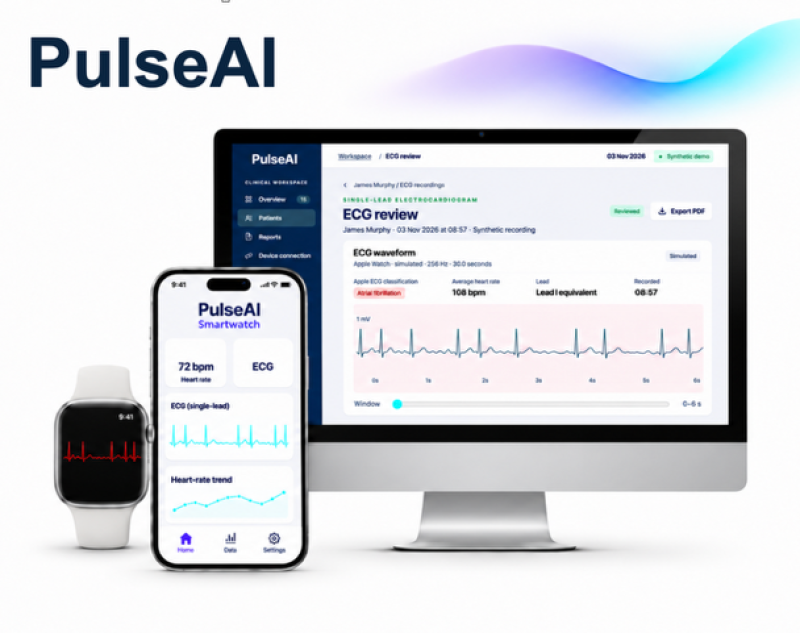
PulseAI, a medical technology company developing artificial intelligence for cardiac diagnostics, today announced U.S. Food and Drug Administration (FDA) 510(k) clearance for its AI-powered arrhythmia analysis model for wearables - this is software that helps analyse heart rhythm recordings and identify potential abnormalities.
Adoption of wearables, including smartwatches, has grown rapidly with most models providing some form of heart rhythm monitoring. According to IDC, 164 million smartwatches were sold worldwide in 2025, extending heart rhythm recording well beyond hospitals and clinics. Today the challenge for healthcare providers is to make use of these recordings without a corresponding increase in the clinical labour required to interpret them.
A significant increased burden arises from inconclusive results. Inconclusive ECG interpretations can increase the workload for healthcare professionals who must review and interpret these recordings. Reducing these unresolved results has the potential to lower the staff time needed to assess patient-generated ECGs, helping clinical services accommodate more recordings with existing resources.
Atrial fibrillation (AFib) is the most common sustained heart rhythm disorder, affecting tens of millions of people worldwide. It can occur without symptoms and, when untreated, is associated with around a fivefold higher risk of ischaemic stroke, depending on individual risk factors. Identifying AFib enables clinicians to assess stroke risk and consider appropriate treatment.
In a prospective study of 296 participants published in Heart Rhythm, PulseAI’s AI algorithm improved AFib detection sensitivity while also reporting a 92% reduction in inconclusive interpretations compared with the Apple Watch’s native algorithm.
Dr Alan Kennedy, CEO and Founder of PulseAI said:
“Wearables have made ECG recording widely accessible. Our ambition is to match expanded access with improved accuracy to help deliver a truly scalable solution to providers.
“Our AI-powered arrhythmia model is an important step toward that goal. With FDA clearance, our focus now is bringing this capability into the devices and platforms in use by millions every day.”
PulseAI’s technology is designed for integration with compatible ECG devices and software platforms. Recordings are submitted for automated analysis in the cloud, with structured results returned to the connected application for clinical review.
From Ulster University research to global healthcare innovation
PulseAI has a longstanding relationship with Ulster University, as a spin-in company, built from collaborative research and innovation.
Founded by Ulster University alumnus and CEO Dr Alan Kennedy, PulseAI's proprietary deep learning technology for advanced ECG analysis was developed in collaboration with research expertise from within the University.
Working as PulseAI Chief Scientist Professor Dewar Finlay, Professor of Electronic Systems and Head of School of Engineering at Ulster University, the partnership has continued to support the journey from academic research to commercial success, with Innovation Ulster Limited (IUL), Ulster University's innovation, commercialisation and venture development company, playing an important role in supporting the company's growth. Innovation Ulster led PulseAI's recent seed funding round alongside the Mortara Group, helping to accelerate the development of its technology.
PulseAI and Ulster University also continue to collaborate through major regional initiatives, including the £2.5 million Digital Health Technologies Accelerator (DHTA) and the Centre for Digital Healthcare Technology (CDHT), working together to advance cardiac diagnostics and the application of artificial intelligence in healthcare.
Professor Paul Bartholomew, Vice Chancellor at Ulster University, said:
"PulseAI is an outstanding example of how pioneering research and expertise, through collaboration with Ulster University, can be transformed into innovative technology with the potential to improve people's lives. Its journey from University spin-in to securing FDA clearance is a significant achievement for the company, the University and Northern Ireland which will benefit patients worldwide.
"This milestone highlights the impact universities can have in driving innovation, investment and high-value jobs while showcasing Northern Ireland's research excellence on the global stage. As an investor through Innovation Ulster Ltd, we warmly congratulate the team and look forward to supporting PulseAI's continued growth and its contribution to advancing cardiac care worldwide."
About PulseAI
PulseAI, founded in 2020, is based in Belfast, Northern Ireland. The company has developed deep learning algorithms trained on millions of ECGs to deliver clinically validated performance across smartwatches, patches, hospital monitors, and defibrillators.