


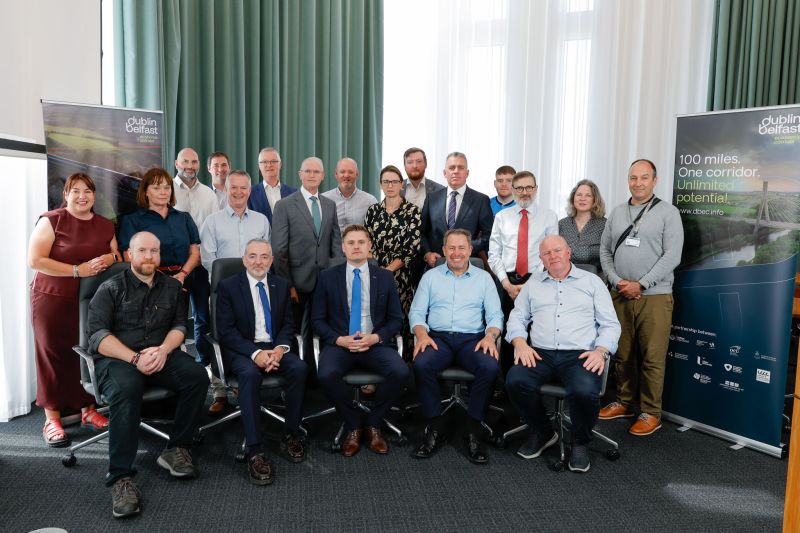
Ulster University hosted the Dublin Belfast Economic Corridor (DBEC) Political Advisory Group (PAG) meeting last week, bringing together elected representatives and senior stakeholders from across the corridor to review progress and discuss priorities for improving cross-border rail connectivity and supporting economic collaboration.
Chaired by Cllr Ryan Carlin, Co-Chair of the DBEC Political Advisory Group, discussions focused on transport, infrastructure and programme delivery, with cross-border rail connectivity and its role in economic growth and regional development a key priority.
Ulster University Deputy Vice Chancellor Professor Paul Seawright outlined Ulster University’s role within the DBEC partnership in supporting regional collaboration, advancing skills development, and contributing evidence-based insights to inform policy across the Corridor.
Ulster University Deputy Vice Chancellor, Professor Paul Seawright said:
“We are pleased to welcome the Dublin Belfast Economic Corridor Political Advisory Group to our Belfast campus. As a partner within the DBEC, Ulster University is committed to supporting regional collaboration, advancing skills development and contributing evidence-based insights to inform policy and progress along the Corridor. We are proud to play our part in helping to strengthen connections and unlock the full potential of this vital economic region.”
A presentation from the Ulster University Economic Policy Centre (UUEPC), led by Principal Economist Dr Eoin Magennis, examined the relationship between rail connectivity and economic performance across the corridor. It highlighted the hourly Enterprise Rail Service as a key driver of business activity, labour mobility, and investment, as well as an important link supporting access to services and cross-border connectivity between communities.
The Political Advisory Group welcomed the recent announcement under the Shared Island initiative of €35 million (£30 million) in continued investment to maintain and enhance the hourly Enterprise service until at least 2030. The Group noted the importance of this commitment in providing long-term certainty for passengers, businesses, and regional planning.
The Enterprise rail service was recognised as a critical strategic asset, strengthening North–South connectivity, supporting housing and employment growth, improving access to skills and education and enhancing the international competitiveness of the Dublin Belfast Economic Corridor.
The Group also received updates on DBEC activity, including outcomes from the recent Industry Advisory Panel meeting in Dundalk, progress on current projects and funding applications, stakeholder engagement activity, and the developing communications approach.
Speaking following the meeting, Co-Chair Cllr Ryan Carlin said:
“DBEC continues to provide a practical platform for cooperation across the Dublin–Belfast corridor. This meeting allowed us to consider the evidence behind key infrastructure priorities and ensure political leadership remains focused on delivering real improvements in cross-border connectivity and economic growth across the region”
The Group reaffirmed its commitment to providing strategic political leadership for the DBEC programme and to working closely with delivery partners, universities and government to ensure future investment is informed by robust evidence and delivers tangible benefits for businesses, communities and the wider economy.