Data Science and Artificial Intelligence MSc
Developing highly skilled professionals in Data Science and Artificial Intelligence.
Elsewhere on Ulster
Developing highly skilled professionals in Data Science and Artificial Intelligence.
Data Science and Artificial Intelligence are rapidly developing, closely connected fields within both academia and industry, with applications across a wide range of sectors. This MSc Data Science and Artificial Intelligence aims to prepare students for successful careers in data science, artificial intelligence, business analytics and related areas. Students will develop skills in data acquisition, information extraction, aggregation and representation, data analysis, statistical modelling, machine learning, deep learning and natural language processing. These skills are in demand across many industries including IT, business, security, health, intelligent transport, energy and the creative industries.
Data, analytics and artificial intelligence capabilities have developed rapidly in recent years. The volume of available data has grown substantially, increasingly sophisticated machine learning and AI techniques have been developed, and computational power and storage have continued to improve. Organisations require professionals with the expertise to harness these developments and derive value from increasingly large and complex datasets. The MSc Data Science and Artificial Intelligence aims to address these needs by providing a firm grounding in the core disciplines of data analytics, statistical modelling, machine learning, artificial intelligence and information processing, alongside an appreciation of the wider disciplines and application areas with which Data Science and AI have natural synergies.
Discover Ulster University’s QS 5 Star ratings, a global mark of excellence recognising outstanding achievement across multiple categories.
QS Stars
We know that choosing to study at university is a big decision, and you may not always be able to find the information you need online.
Please contact Ulster University with any queries or questions you might have about:
For any queries regarding getting help with your application, please select Admissions in the drop down below.
For queries related to course content, including modules and placements, please select Course specific information.
We look forward to hearing from you.
QS Stars
This specialist Master's course in Data Science and Artificial Intelligence is aimed at highly motivated graduates with a good honours degree in computing, engineering or a related discipline. While the course has a particular focus on the employment needs of the local economy, the skills and abilities developed are readily transferable to a global context.
Organisations increasingly require professionals who can combine expertise in data, analytics and artificial intelligence with an understanding of real-world problems and application domains. Extracting meaningful information from increasingly large and complex datasets presents significant challenges, while advances in machine learning and artificial intelligence are creating new opportunities for data-driven analysis and decision-making. This course enables graduates to embark on professional careers in Data Science, Artificial Intelligence and related areas, developing the advanced analytical and computational skills needed to contribute to this rapidly changing landscape.
Modules
Here is a guide to the subjects studied on this course.
Courses are continually reviewed to take advantage of new teaching approaches and developments in research, industry and the professions. Please be aware that modules may change for your year of entry. The exact modules available and their order may vary depending on course updates, staff availability, timetabling and student demand.
Big Data Technologies:Within this module, a variety of database and data storage paradigms will be explored, ranging from traditional relational database systems to NoSQL databases, object stores, time-series databases and graph databases. Consideration will be given to the challenges associated with storing, managing and querying high-volume, high-variety and high-velocity data. The cloud computing paradigm will also be introduced, including how cloud-based platforms can provide scalable computational and storage resources. Core concepts in distributed computing will be examined in the context of technologies such as Hadoop and Spark. Students will develop both practical and theoretical understanding of distributed data-processing workflows, functional programming concepts and approaches such as MapReduce.
Business Intelligence and Analytics: This module explores the role of Business Intelligence and Business Analytics and why they are important within modern organisations. A particular focus will be on how stored data can be transformed into valuable information to support decision-making. For example, large volumes of data relating to an organisation’s customers and operations are routinely collected and stored in corporate data warehouses and other data repositories. This data can provide significant value when analysed effectively. Students will explore techniques and tools for data analysis and for presenting results to non-technical and managerial audiences in alignment with business objectives. The module will also consider the ethical, privacy and consent issues associated with Business Intelligence and Analytics, together with the risks arising from their use.
Data Validation and Visualisation: High-quality data is a prerequisite for effective data analysis and for ensuring that meaningful and reliable insights can be derived from data. This module introduces the data quality challenges associated with large and complex datasets and presents tools and techniques for assessing data quality and identifying and addressing errors and inconsistencies. Students will develop the knowledge and skills required to evaluate data quality and perform appropriate data cleaning and preprocessing operations. The module also introduces approaches to understanding, exploring and interpreting data through descriptive statistical methods, including statistical measures, univariate analysis and multivariate analysis. In addition, students will develop skills in processing, interpreting and visualising data to communicate meaningful insights.
Deep Learning and Natural Language Processing: Deep Learning and Natural Language Processing (NLP) are important areas of Artificial Intelligence, with applications across domains such as web search, advertising, email filtering, customer service, language translation and healthcare. As language is a primary means of human communication, the ability to process and interpret it is a key aspect of AI. A wide range of machine learning models underpin NLP applications, and deep learning approaches have achieved strong performance across many NLP tasks. In this module, students will learn to implement, train, debug, evaluate and visualise neural network models for NLP applications. The module provides an in-depth exploration of deep learning techniques as applied to language data. Topics covered may include word vector representations, window-based neural networks, recurrent neural networks, long short-term memory models, recursive neural networks, convolutional neural networks, and models incorporating memory components. Students will also develop the practical skills and engineering techniques required to apply neural networks effectively to real-world problems.
Statistical Modelling and Machine Learning: This module provides a systematic understanding of probability and statistics before introducing the statistical modelling process and approaches to testing research hypotheses. It then explores key concepts and techniques in data mining, machine learning and exploratory data analysis. Students will develop practical experience through lectures, seminars and hands-on exercises using tools such as Python, R and Weka. On completion of the module, students will be able to compute and interpret conditional probabilities, apply hypothesis testing appropriately, understand statistical measures such as p-values, and apply, evaluate and critically appraise statistical and machine learning techniques across a range of complex real-world contexts.
Research Masters Project: The aim of the project is to enable students to demonstrate their ability to undertake an independent research project, which may involve developing theoretical perspectives, addressing research questions using data, or analysing and developing solutions to real-world problems. Students will be expected to apply appropriate research methodologies and demonstrate the knowledge and skills developed throughout the course. As part of the project, students will critically engage with relevant literature, develop and refine ideas, and apply appropriate methods to address the chosen research problem. This may involve the collection and analysis of primary or secondary data, using qualitative or quantitative approaches, and/or the analysis of current industrial processes. The Masters project represents a substantial piece of independent work undertaken under appropriate academic supervision. It draws on both the practical and creative aspects of problem-solving and the scholarly investigation of a defined area of study. The work must demonstrate originality and include a critical appraisal of the subject area.
Ulster University academics are actively involved in both research and teaching, ensuring that current research and developments in the field inform the student learning experience. A high proportion of staff hold Advance HE Fellowship, and academic staff are expected to hold a Postgraduate Certificate in Higher Education Practice/University Teaching or an equivalent qualification. All Computing courses are subject to periodic review and University revalidation.
Optional modules are reviewed on a Programme each year and we may change the options available to you, to reflect our staff expertise, changes in Programme requirements or to reflect feedback that we have received from other Students, employers or other interested parties.
If your Programme contains optional modules, you will be provided with a list of these in good time so that you can choose the options right for you each year. Sometimes, we may not be able to run a particular optional module because not enough Students sign up for it or because a member of staff is not available to teach a module. Where this may be the case, we will let you know when you are provided with your option choices, and you will be able to choose an alternative if one of your selected modules does not run.
The programme is delivered in person at the Derry~Londonderry campus and is not available through distance or online learning.
The part-time provision offers two points of entry each academic year, in September and January. The six taught modules are normally completed over four semesters across two academic years. The Masters Research Project is normally completed in the third year. For the September intake, students may choose to begin the project in the summer of Year 2, allowing the programme to be completed earlier.
Teaching is delivered through a combination of lectures, tutorials, seminars and practical sessions. Students also receive support in preparing for and undertaking their research project.
The course is assessed by coursework.
The content for each course is summarised on the relevant course page, along with an overview of the modules that make up the course.
Each course is approved by the University and meets the expectations of:
As part of your course induction, you will be provided with details of the organisation and management of the course, including attendance and assessment requirements - usually in the form of a timetable.
For full-time courses, the precise timetable for each semester is not confirmed until close to the start date and may be subject to some change in the early weeks as all courses settle into their planned patterns. A course handbook is also made available.

Courses comprise modules for which the notional effort involved is indicated by its credit rating. Each credit point represents 10 hours of student effort. Postgraduate courses are typically 15 or 30 credit modules.
Postgraduate Master’s courses typically comprise 180 credits, taken in three semesters when studied full-time. A Postgraduate Certificate (PGCert) comprises 60 credits and can usually be completed on a part-time basis in one year. A 120-credit Postgraduate Diploma (PGDip) can usually be completed on a part-time basis in two years.
Class contact times vary by course and type of module. Typically, for a module predominantly delivered through lectures you can expect at least 3 contact hours per week (lectures/seminars/tutorials). Laboratory classes often require a greater intensity of attendance in blocks. Some modules may combine lecture and laboratory. The precise model will depend on the course you apply for and may be subject to change from year to year for quality or enhancement reasons. Prospective students will be consulted about any significant changes.
Assessment methods vary and are defined explicitly in each module. Assessment can be a combination of examination and coursework but may also be only one of these methods. Assessment is designed to assess your achievement of the module’s stated learning outcomes. You can expect to receive timely feedback on all coursework assessments. This feedback may be issued individually and/or issued to the group, and you will be encouraged to act on this feedback for your own development.
Coursework can take many forms, for example: essay, report, seminar paper, test, presentation, dissertation, design, artefacts, portfolio, journal, group work. The precise form and combination of assessment will depend on the course you apply for and the module. Details will be made available in advance through induction, the course handbook, the module specification, the assessment timetable and the assessment brief. The details are subject to change from year to year for quality or enhancement reasons. You will be consulted about any significant changes.
Normally, a module will have 4 learning outcomes, and no more than 2 items of assessment. An item of assessment can comprise more than one task. The notional workload and the equivalence across types of assessment is standardised. The module pass mark for postgraduate courses is 50%.
Classification of integrated Master’s degrees with Honours include a Level 7 component. The calculation in this case is: 50% Level 7, 30% Level 6, 20% Level 5. At least half the Level 5 modules must be studied at the University for Level 5 to be included in the calculation of the class. All other qualifications have an overall grade determined by results in modules from the final level of study.
In Masters degrees of more than 200 credit points the final 120 points usually determine the overall grading.
QS Stars
Ulster University is situated in the heart of Derry~Londonderry, the capital of the North West. Located where the Wild Atlantic Way meets the Causeway Coastal route, and only a short distance from idyllic County Donegal.
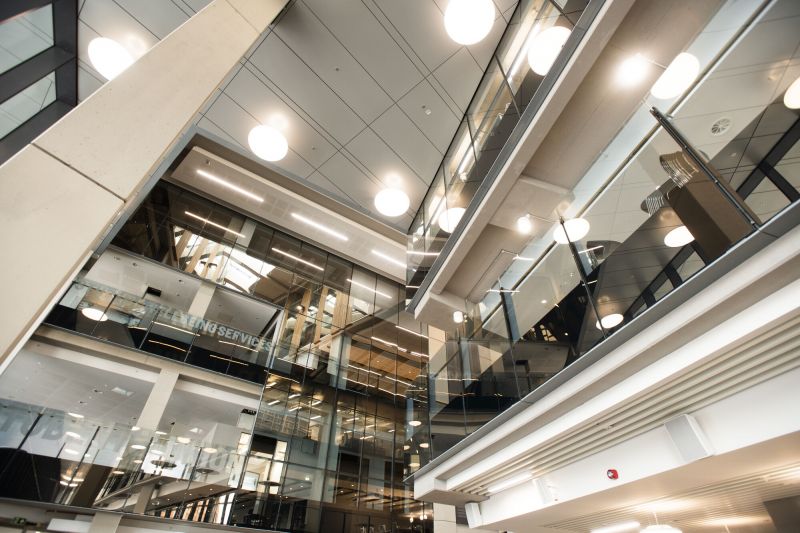
Explore the spaces, studios and social areas you'll use while studying at our Derry~Londonderry campus. Prefer to explore at your own pace? Take the 360° virtual campus tour.
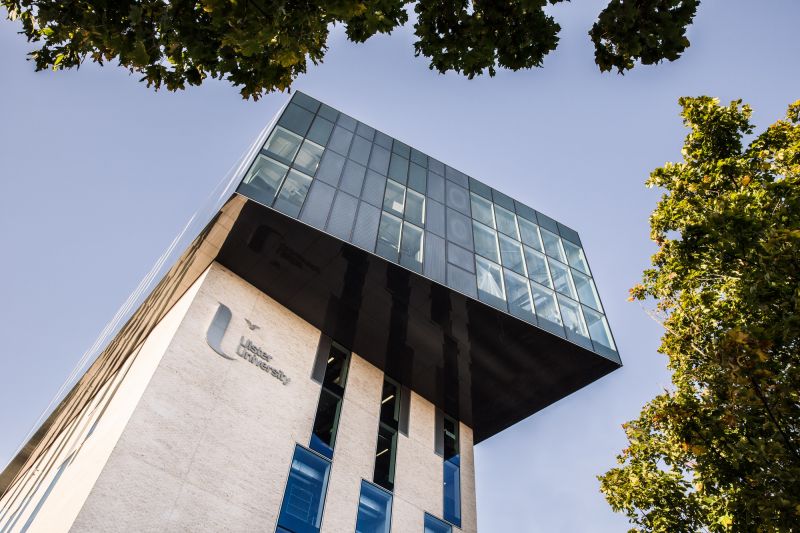
Derry~Londonderry offers a city location with a friendly vibe. Impressive, historic buildings such as our iconic Martha Magee building blend perfectly with our modern state-of-the-art teaching blocks and library facilities, including our School of Medicine.
Our Sports Yard that sits alongside the School of Health Sciences provides active spaces and an indoor gym and studios to enhance student wellbeing and experience in Derry~Londonderry.
The City of Derry is famous for its festivals, including the Foyle Film Festival, Halloween celebrations, Maritime Festival, and Derry Jazz and Big Band Festival. The vibrant nightlife - recognised with Purple Flag status for being safe and welcoming - is complemented by a wide range of cultural venues and activities, and the city’s fame has spread thanks to the popular TV show Derry Girls. Alongside being one of the most affordable places to live in the UK, the friendliness of the people of Derry~Londonderry will make your student experience truly ‘Legenderry’.
Dive deeper into the places, services and virtual experiences that will shape your student life in Derry~Londonderry.
We recognise a range of qualifications for admission to our courses. In addition to the specific entry conditions for this course you must also meet the University’s General Entrance Requirements.
Applicants must:
(a) have gained
(i) a second class honours degree or better, in the subject areas of computing, engineering or related discipline, from a university of the United Kingdom or the Republic of Ireland, or from a recognised national awarding body, or from an institution of another country which has been recognised as being of an equivalent standard; or
(ii) an equivalent standard (normally 50%) in a Graduate Diploma, Graduate Certificate, Postgraduate Certificate or Postgraduate Diploma or an approved alternative qualification; and the qualification must be in the subject areas of computing, engineering or related discipline
and
(b) provide evidence of competence in written and spoken English (GCSE grade C or equivalent).
In exceptional circumstances, as an alternative to (a) (i) or (a) (ii) and/or (b), where an individual has substantial and significant experiential learning, a portfolio of written evidence demonstrating the meeting of graduate qualities (including subject-specific outcomes, as determined by the Course Committee) may be considered as an alternative entrance route. Evidence used to demonstrate graduate qualities may not be used for exemption against modules within the programme.
English language requirements for international applicants
The minimum requirement for this course is Academic IELTS 6.0 with no band score less than 5.5. Trinity ISE: Pass at level III also meets this requirement for Tier 4 visa purposes.
Ulster recognises a number of other English language tests and comparable IELTS equivalent scores.
The entry requirements facilitate accreditation of prior learning.
QS Stars
The course is designed to enhance employability by providing opportunities for students to apply their learning within real industrial and commercial contexts. The MSc Data Science and Artificial Intelligence draws on the University's business and industry links to support industrially relevant teaching and project work. Where appropriate, student projects may provide opportunities to address real-world problems and engage with industrial or research contexts, allowing students to apply the knowledge and skills developed throughout the course.
Graduates will develop skills relevant to a wide range of careers involving data, analytics and artificial intelligence. Potential roles include Data Scientist, Data Analyst, Machine Learning Engineer, AI Engineer, Business Intelligence Analyst and other data- and AI-focused roles. These skills are applicable across sectors including technology, financial services, consulting, healthcare, manufacturing, government, education and the wider public sector.
This programme does not include a work placement.
Accreditations reflect the excellence of our teaching, research, and knowledge exchange and ensure our programmes realise the highest expectations. By studying at Ulster University you’ll gain insight and be at the forefront of current industry practices, while our many accredited degree programmes open doors to the world’s top professional organisations, making you more attractive to future employers and giving you a competitive edge in the job market.
Accredited by BCS, the Chartered Institute for IT for the purposes of partially meeting the academic requirement for registration as a Chartered IT Professional.
Accredited by BCS, the Chartered Institute for IT on behalf of the Engineering Council for the purposes of partially meeting the academic requirement for registration as a Chartered Engineer.
Accredited by The Institute of Analytics (IoA) which is the Professional Body for Analytics and Data Science Professionals worldwide.
Postgraduate fees are subject to annual review, 2027/28 fees will be announced in due course.
See our tuition fees page for the current fees for 2026/27 entry.
Sponsored industry prizes.
See if you can access financial or other forms of support, including mentorship to excel in your studies.
None
It is important to remember that costs associated with accommodation, travel (including car parking charges) and normal living will need to be covered in addition to tuition fees.
Where a course has additional mandatory expenses (in addition to tuition fees) we make every effort to highlight them above. We aim to provide students with the learning materials needed to support their studies. Our libraries are a valuable resource with an extensive collection of books and journals, as well as first-class facilities and IT equipment. Computer suites and free Wi-Fi are also available on each of the campuses.
There are additional fees for examination resits and library fines. Where a graduation ceremony is part of your course, please be aware that additional fees will apply.
Students choosing a period of paid work placement or study abroad as a part of their course should be aware that there may be additional travel and living costs, as well as tuition fees.
See the tuition fees on our student guide for most up to date costs.
QS Stars
Ulster continues to develop and support sustainability initiatives with our staff, students, and external partners across various aspects of teaching, research, professional services operations, and governance.
At Ulster every person, course, research project, and professional service area on every campus either does or can contribute in some way towards the global sustainability and climate change agenda.
We are guided by both our University Strategy People, Place and Partnerships: Delivering Sustainable Futures for All and the UN Sustainable Development Goals.
Our work in this area is already being recognised globally. Most recently by the 2024 Times Higher Education Impact rating where we were recognised as Joint 5th Globally for Outreach Activities and Joint Top 20 Globally for Sustainable Development Goal 17: Partnership for the Goals.
Visit our Sustainability at Ulster destination to learn more about how the University strategy and the activities of Ulster University support each of the Sustainable Development Goals.
We are passionate about sharing with our students the vital role they each have now and as future professionals in promoting a sustainable future for all. We believe that sustainability is not the domain of one discipline or profession. It is the responsibility of all disciplines, professions, organisations and individuals.
That is why on each of our courses within the School of Computing, Engineering and Intelligent Systems you will learn about the UN Sustainable Development Goals and the contribution you can make now, and as a graduate in Computing or Engineering.
![]()
1. We prepare our prospectus and online information about our courses with care and every effort is made to ensure that the information is accurate. The printed version of the prospectus is, however, published at least a year before the courses begin. Information included in the prospectus may, therefore, change. This includes, but is not limited to changes to the terms, content, delivery, location, method of assessments or lengths of the courses described. Not all circumstances are foreseeable, but changes will normally be made for one of the following reasons:
2. If there are insufficient enrolments to make a course viable, it may be necessary for the University to withdraw a course. If you have received an offer for a course that we subsequently have to close, we will contact you as soon as possible to discuss alternative courses. If you do not wish to study any alternative courses at the University, you may withdraw your application by informing us by email to admissions@ulster.ac.uk.
3. Please note that the University’s website is the most up-to-date source of information regarding courses, campuses and facilities and we strongly recommend that you always visit the website before making any commitments.
4. We will include a durable PDF when we send you an offer letter which will highlight any changes made to our prospectus or online information about our courses. You should read this carefully and ensure you fully understand what you are agreeing to before accepting a place on one of our courses.
5. The University will always try to deliver the course as described in the durable PDF you receive with your offer letter.
6. At any point after an offer has been made, students will be notified of any course changes in writing (usually by email) as soon as reasonably practicable and we will take all reasonable steps to minimise their impact where possible. The University will, where possible and reasonably practicable, seek the express consent of the student in regard to any changes concerning material or pre-contract information.
7. The University website will be updated to reflect the changed course information as soon as reasonably practicable.
8. If, after due consideration, you decide that you no longer want to study your course or to study at the University because of the changes, you may withdraw your application or terminate your contract with the University. In order to do so, you should notify us in writing by emailing admissions@ulster.ac.uk (and update UCAS if applicable). We will, on request, recommend alternative courses that you could study with us, or suggest a suitable course at an alternative higher education provider.
9. If you do not agree that the changes are fair, you can seek redress under the Student Complaints Procedures.
10. Providing the University has complied with the requirements of all applicable consumer protection laws, the University does not accept responsibility for the consequences of any modification, relocation or cancellation of any course, or part of a course, offered by the University. The University will give due and proper consideration to the effects thereof on individual students and take the steps necessary to minimise the impact of such effects on those affected.
11. The University is not liable for disruption to its provision of educational or other services caused by circumstances beyond its reasonable control providing it takes all reasonable steps to minimise the resultant disruption to such services.
12. The published Academic Calendar sets out the University’s standard teaching, assessment, and vacation periods. These dates do not apply to all programmes. Individual programmes may operate different start dates, teaching periods, assessment schedules, or vacation arrangements, and some may include teaching or assessment outside the standard University terms. This is particularly common for programmes with professional accreditation requirements, clinical or practice‑based teaching, placements, fieldwork, or intensive study blocks. Full‑time 12‑month programmes, particularly postgraduate taught courses, may operate across the full academic year and typically continue through the summer period without a standard vacation break.
Applicants and students should not rely solely on the central academic calendar when making decisions about accommodation, travel, employment, or other commitments. Programme‑specific schedules will normally be confirmed in programme information, offer documentation and programme handbooks.
The University takes reasonable steps to ensure the accuracy of published information but reserves the right to make changes where reasonably necessary, including to maintain academic standards or to comply with regulatory or professional requirements. Where changes materially affect students, the University will take reasonable steps to notify affected students and applicants in advance where possible.
13. Further information can be found in our terms and conditions.

The full Student Terms and Conditions is now available.