Elsewhere on Ulster
The global games industry continues to grow from a projected $220 billion in 2025 to $266 billion dollars by 2028 and provides opportunities for lucrative careers at the cutting-edge of technology with high levels of demand for talented games programmers worldwide [1].
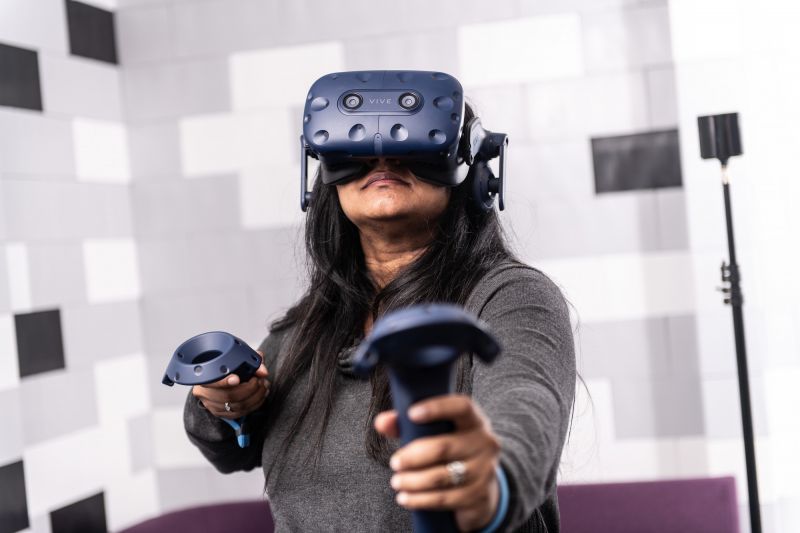
The BSc (Hons) Computer Science (Games Programming) degree equips you with the specialised knowledge and essential skills required to excel in the games industry. It explories topics including gameplay programming, game prototyping, games AI, virtual/augmented reality, tools development and software engineering while using industry-standard games development software. It provides opportunities to develop essential teamwork and communication skills to work in effectively in collaborative, dynamic environments.
[1] [https://www.bcg.com/press/12december2024-future-of-global-gaming-industry
We know that choosing to study at university is a big decision, and you may not always be able to find the information you need online.
Please contact Ulster University with any queries or questions you might have about:
For any queries regarding getting help with your application, please select Admissions in the drop down below.
For queries related to course content, including modules and placements, please select Course specific information.
We look forward to hearing from you.
Ever wondered what makes your favorite video games tick?
Behind every immersive gaming experience lies the expertise of games programmers who blend technical ability and creativity weaving together gameplay mechanics, stunning visuals, and immersive soundscapes to breathe life into these virtual worlds through code.
By undertaking this course you with gain the critical skills and insights needed, along with a thorough understanding of the games industry, to thrive as a games programmer paving the way for a fulfilling career in this area.
Outside of traditional learning, you can undertake additional activities e.g. game jams and hackathons to build your portfolio and create networks of industry contacts.
Diploma in Professional Practice DPP
Diploma in Professional Practice International DPPI
Diploma in International Academic Studies DIAS
Four years, including placement.
Each student must complete 120 credits (usually six modules) in each academic year, with the exception of placement year (60 credits). Years 1, 2 and 4 are spent in the University. Modules are taught on campus and are web-supplemented. In Year 3, students undertake a year's work experience.
Members of the teaching team are Fellows of the Higher Education Academy and Members of the industry professional body - the BCS, the Chartered Institute for IT. Through their research, knowledge transfer and placement activities, teaching staff are also actively engaged with the local software and IT industry, and many modules on the course are directly informed by staff research activities.
Lectures are used to present theory and concepts and are supported through a combination of tutorial discussion and practical, laboratory exercises. Students will be directed to read sections of recommended texts and will be expected to undertake directed reading in preparation for all scheduled classes, and to consolidate the material covered in class by private study.
Modules are assessed by coursework only. Coursework assessment is carried out using any combination of written assignments, class tests, practical tests, presentations, and group assignments as appropriate to meet the learning outcomes of each module.
The content for each course is summarised on the relevant course page, along with an overview of the modules that make up the programme.
The content for each course is summarised on the relevant course page, along with an overview of the modules that make up the course.
Each course is approved by the University and meets the expectations of:
As part of your course induction, you will be provided with details of the organisation and management of the course, including attendance and assessment requirements - usually in the form of a timetable. For full-time courses, the precise timetable for each semester is not confirmed until close to the start date and may be subject to some change in the early weeks as all courses settle into their planned patterns. For part-time courses which require attendance on particular days and times, an expectation of the days and periods of attendance will be included in the letter of offer. A course handbook is also made available.
Courses comprise modules for which the notional effort involved is indicated by its credit rating. Each credit point represents 10 hours of student effort. Undergraduate courses typically contain 10, 20, or 40 credit modules (more usually 20) and postgraduate courses typically 15 or 30 credit modules.
The normal study load expectation for an undergraduate full-time course of study in the standard academic year is 120 credit points. This amounts to around 36-42 hours of expected teaching and learning per week, inclusive of attendance requirements for lectures, seminars, tutorials, practical work, fieldwork or other scheduled classes, private study, and assessment. Teaching and learning activities will be in-person and/or online depending on the nature of the course. Part-time study load is the same as full-time pro-rata, with each credit point representing 10 hours of student effort.
Postgraduate Master’s courses typically comprise 180 credits, taken in three semesters when studied full-time. A Postgraduate Certificate (PGCert) comprises 60 credits and can usually be completed on a part-time basis in one year. A 120-credit Postgraduate Diploma (PGDip) can usually be completed on a part-time basis in two years.
Class contact times vary by course and type of module. Typically, for a module predominantly delivered through lectures you can expect at least 3 contact hours per week (lectures/seminars/tutorials). Laboratory classes often require a greater intensity of attendance in blocks. Some modules may combine lecture and laboratory. The precise model will depend on the course you apply for and may be subject to change from year to year for quality or enhancement reasons. Prospective students will be consulted about any significant changes.
Assessment methods vary and are defined explicitly in each module. Assessment can be a combination of examination and coursework but may also be only one of these methods. Assessment is designed to assess your achievement of the module’s stated learning outcomes. You can expect to receive timely feedback on all coursework assessments. This feedback may be issued individually and/or issued to the group and you will be encouraged to act on this feedback for your own development.
Coursework can take many forms, for example: essay, report, seminar paper, test, presentation, dissertation, design, artefacts, portfolio, journal, group work. The precise form and combination of assessment will depend on the course you apply for and the module. Details will be made available in advance through induction, the course handbook, the module specification, the assessment timetable and the assessment brief. The details are subject to change from year to year for quality or enhancement reasons. You will be consulted about any significant changes.
Normally, a module will have 4 learning outcomes, and no more than 2 items of assessment. An item of assessment can comprise more than one task. The notional workload and the equivalence across types of assessment is standardised. The module pass mark for undergraduate courses is 40%. The module pass mark for postgraduate courses is 50%.
The class of Honours awarded in Bachelor’s degrees is usually determined by calculation of an aggregate mark based on performance across the modules at Levels 5 and 6, (which correspond to the second and third year of full-time attendance).
Level 6 modules contribute 70% of the aggregate mark and Level 5 contributes 30% to the calculation of the class of the award. Classification of integrated Master’s degrees with Honours include a Level 7 component. The calculation in this case is: 50% Level 7, 30% Level 6, 20% Level 5. At least half the Level 5 modules must be studied at the University for Level 5 to be included in the calculation of the class.
All other qualifications have an overall grade determined by results in modules from the final level of study.
In Masters degrees of more than 200 credit points the final 120 points usually determine the overall grading.
Figures from the academic year 2022-2023.
The University employs over 1,000 suitably qualified and experienced academic staff - 60% have PhDs in their subject field and many have professional body recognition.
Courses are taught by staff who are Professors (19%), Readers, Senior Lecturers (22%) or Lecturers (57%).
We require most academic staff to be qualified to teach in higher education: 82% hold either Postgraduate Certificates in Higher Education Practice or higher. Most academic and learning support staff (85%) are recognised as fellows of the Higher Education Academy (HEA) by Advance HE - the university sector professional body for teaching and learning. Many academic and technical staff hold other professional body designations related to their subject or scholarly practice.
The profiles of many academic staff can be found on the University’s departmental websites and give a detailed insight into the range of staffing and expertise. The precise staffing for a course will depend on the department(s) involved and the availability and management of staff. This is subject to change annually and is confirmed in the timetable issued at the start of the course.
Occasionally, teaching may be supplemented by suitably qualified part-time staff (usually qualified researchers) and specialist guest lecturers. In these cases, all staff are inducted, mostly through our staff development programme ‘First Steps to Teaching’. In some cases, usually for provision in one of our out-centres, Recognised University Teachers are involved, supported by the University in suitable professional development for teaching.
Figures from the academic year 2022-2023.
High quality student accommodation in Derry~Londonderry, one of Europe's most vibrant cities. Located close to the campus and city centre, offering a supportive and vibrant living environment.
Find out more - information about accommodation (Opens in a new window)
Our facilities in Derry~Londonderry cater for many sports ranging from archery to volleyball, and are open to students and members of the public all year round.
Find out more - information about sport (Opens in a new window)
At Student Wellbeing we provide many services to help students through their time at Ulster University.
Find out more - information about student wellbeing (Opens in a new window)
Here is a guide to the subjects studied on this course.
Courses are continually reviewed to take advantage of new teaching approaches and developments in research, industry and the professions. Please be aware that modules may change for your year of entry. The exact modules available and their order may vary depending on course updates, staff availability, timetabling and student demand. Please contact the course team for the most up to date module list.
Year: 1
Status: C
This module provides students of computing with an initial competence in the development of software through the medium of a modern programming language with facilities for both structured and object-oriented programming
Year: 1
Status: C
This module is a direct follow-on to Software Development I. Students are introduced to more advanced features of both an algorithmic programming language and an object oriented language, and will be expected to acquire a higher level of competence in writing software.
Year: 1
Status: C
Differences in the internal structure and organisation of a computer lead to significant differences in performance and functionality, giving rise to an extraordinary range of computing devices, from hand-held computers to large-scale, high-performance machines. This module addresses the various options involved in designing a computer system, the range of design considerations, and the trade-offs involved in the design process.
Year: 1
Status: C
This module provides students with knowledge of the fundamental social, business and technical issues associated with the design, development and publishing of computer and video games. It explores the use of artificial intelligence in this context. The module explores the game development industry in terms of the people, processes, tools and technologies involved in the creation of modern games.
Year: 1
Status: C
This module will provide students with a detailed knowledge of the fundamental issues facing designers in creating compelling, engaging games and game play mechanics from a contemporary and historical context. It will provide a theoretical underpinning to practical game design.
Year: 1
Status: C
This module provides students with a solid foundation in the fundamental topics in engineering mathematics. The material develops the student's competencies in the essential mathematics that forms an integral part of an undergraduate honours degree in engineering related disciplines.
Year: 2
Status: C
This module builds on programming foundations covered in Year 1 and provides a foundation for the Web development modules in Year 2 and 4. In addition, it offers an appreciation of user factors in application design and provides students with the tools to specify and develop high quality user interfaces across all modules.
Year: 2
Status: C
This module builds on knowledge and skills attained in previous modules, i.e., core programming concepts and capabilities involving loops, conditions, functions, problem-solving, design, and logical thinking.Typically, a student's first exposure to programming in our degree is with Java, and in this module will have an opportunity to learn a new language (e.g., C#, C++, or Python).
Students will have an opportunity to increase their coding skills and learn about more complex programming and software engineering concepts such as Object Orientation, Decomposition, Functional Programming, Memory Management, Input/Output, Exception Handling, Testing, Debugging, and Version Control. Students will design and implement code solutions to set problems both individually and in groups.
Year: 2
Status: C
The module builds upon the expertise acquired in Year 1 software development. Students are introduced to the classic data structures and algorithms that are used to process them, the specification of methods and classes and the measurement of algorithm performance.
Year: 2
Status: C
The module covers the fundamental principles and theory of 3D game programming, design and development and provides practical experience in pitching and developing 3D games using a range of techniques, industry standard tools and technologies. It explores the practical use of artificial intelligence tools in this context. It places a focus on the importance of teamwork, planning, project management, version control and emerging technologies in the game development and implementation process.
Year: 2
Status: C
The module covers the fundamental principles and theory of 2D game programming, design and development and provides practical experience in pitching and developing 2D games using a range of techniques, industry standard tools, artificial intelligence and technologies. It places a focus on the importance of teamwork, planning, project management and version control in the game development and implementation process.
Year: 2
Status: C
This module provides students with a solid foundation in essential mathematics required for further study in engineering or related fields. It focuses on developing the mathematical skills needed to solve problems encountered during their undergraduate studies. The content is introduced in a practical and engaging way, helping students connect mathematical theory to real-world problems, making the concepts more meaningful and relevant for their future careers.
The module encourages a spirit of mathematical inquiry and discovery, fostering confidence in problem-solving. Students will engage in interactive learning and collaborative exercises, which will help them build both theoretical knowledge and practical problem-solving skills.
To support their learning, students will be introduced to MATLAB, a tool for numerical computing that will help them explore and visualise mathematical concepts. However, the primary focus remains on developing mathematical theory and its application, with programming serving as a supplementary tool.
Assessment will ensure a balanced approach to both theory and application.
Year: 2
Status: C
This module is designed to equip students with the appropriate research and transferable skills needed to secure employment within the Computing and Engineering domain.
The module prepares students for professional work by developing knowledge of the responsibilities and obligations of employees, employers and clients as determined by codes of professional conduct. Students will have the opportunity to practise the presentation of themselves in, for example, application forms, curriculum vitae, interview, elevator pitches and aptitude tests.
The module provides an underpinning foundation of research concepts, methods and techniques necessary for project development and delivery. The students employ research skills developed during the module to gather research from a variety of sources and critically review this literature. Embedded in all these activities is the reinforcement of the need for adhering to recognised ethical standards and taking a professional approach to employability.
Year: 3
Status: C
This module provides undergraduate students with an opportunity to gain structured and professional work experience, in a work-based learning environment, as part of their planned programme of study. This experience allows students to develop, refine and reflect on their key personal and professional skills. The placement should significantly support the development of the student's employability skills, preparation for final year and enhance their employability journey.
Year: 4
Status: C
This module provides a theoretical foundation in the area of concurrent and distributed systems. This is an increasingly important area of computing as these types of systems are now manifest in a wide range of internet/intranet based application domains. The module first covers the key theory and design principles and then provides a learning path for software development in this exciting and evolving area of computing/engineering. As a consequence it facilitates students to develop expertise in the core skills area of multithreaded, networked and web-enabled computer systems.
Year: 4
Status: C
This module addresses and develops understanding and knowledge of key and emerging concepts associated with mobile technologies, and fosters related mobile application software design and development principles.
Year: 4
Status: C
The module provides an in-depth overview into the theoretical and technical issues underpinning mixed reality application design and development and provides practical experience in pitching and developing mixed reality applications using a range of techniques, industry standard tools, skills artificial intelligence and technologies. It emphasises the important role of testing and user feedback in the development and implementation process. The module will explore emerging technologies, business models and market trends in the industry.
Year: 4
Status: C
Students are required to undertake a major project during the final year of the course. The module offers students an opportunity to develop a realistic and meaningful piece of work during their final year. This module allows a chosen subject area to be researched in depth and a solution developed as a consequence. Students will have the opportunity to integrate and apply the learning achieved from other modules in the course. The module runs during both semesters and allows students to develop a comprehensive approach to all aspects of working on a large project. The project encourages innovation and creative thinking in the development of the solution. It also develops the entrepreneurial mindset, which can influence the challenges undertaken and final decisions made.
Year: 4
Status: C
This module will provide students with an understanding of the computational intelligence research area. The module addresses both existing techniques used individually and in hybrid forms. The module also introduces the current research topics within this domain, of Fuzzy Logic and Approximate Reasoning and Neuro-computing.
We recognise a range of qualifications for admission to our courses. In addition to the specific entry conditions for this course you must also meet the University’s General Entrance Requirements.
The entry conditions below apply to applicants presenting qualifications from Northern Ireland, the Republic of Ireland or Great Britain.
BBC
A Level Essential:
One subject from Mathematics, Further Mathematics, Physics, Chemistry, Computer Science, Software Systems Development, Electronics or Technology & Design.
Reduced Offer:
Applicants presenting with an A Level in Mathematics, Further Mathematics or Physics will receive a reduced offer of BCC.
DMM
The following qualifications will be accepted:
Pearson BTEC Level 3 National Extended Certificate in Computing (601/7341/5)
Pearson BTEC Level 3 National Diploma in Computing (603/0445/5)
Pearson BTEC Level 3 National Extended Diploma in Computing (601/7342/7)
Pearson Level 3 Alternative Academic Qualification BTEC National in Computing (Extended Certificate) (610/3963/9)
Pearson BTEC Level 3 National Extended Certificate in Engineering (601/7584/9)
Pearson BTEC Level 3 National Diploma in Engineering (601/7580/1)
Pearson BTEC Level 3 National Extended Diploma in Engineering (601/7588/6)
Pearson Level 3 Alternative Academic Qualification BTEC National in Engineering (Extended Certificate) (610/3962/7)
112 UCAS tariff points to include a minimum of five subjects (four of which must be at higher level)
You will be required to have H3 in two of the following subjects: Mathematics, Applied Mathematics, Physics, Chemistry, Computer Science, Engineering or Technology.
If Mathematics is not passed at H3, you will be required to achieve a minimum of H6 if studied at Higher Level or O4 if studied at Ordinary Level in addition to two of the subjects listed above.
You will also be required to have English at minimum H6 if studied at Higher Level or O4 if studied at Ordinary Level.
Overall profile of 63% (120-credit Access Course)
Overall profile of 15 credits at Distinction and 30 credits at Merit (60-credit Access to HE Diploma). This means you'll need 15 credits at Distinction and 30 credits at Merit level.
NI Access Course - to include a 20 credit Level 2 Mathematics module, passed at 40% or successful completion of NICATS Mathematics as part of the pre-2021 Access Diploma, if applicant doesn't possess at least GCSE Maths grade C.
GB Access to HE Diploma - Plus GCSE English & Maths at least grade C.
Subject area must be in Mathematics, Computing or Engineering
GCSE English Language at Grade C/4 or above.
GCSE Mathematics at Grade C/4 or above.
Level 2 Certificate in Essential Skills Application of Number is NOT regarded as an acceptable alternative to GCSE Mathematics.
The majority of students enter this programme in year 1 at Level 4. However, applicants who provide evidence of previous relevant successful study may be considered for entry to Level 5 of the programme. Exceptionally applicants may be considered for entry at Level 6. Transfer will normally be admitted with exemptions depending on prior accredited knowledge.
Transfer between this course and other similar courses within the Faculty of Computing, Engineering and the Built Environment may be possible on the basis of academic performance and availability of places.
Exemption from parts of the course may be considered based on appropriate performance in a related, designated course or other approved experiential learning (APEL).
The course has been designed to enable students who graduate with a good honours degree to apply for postgraduate study towards a PhD, MSc, MRes or other higher qualification.
With this degree you could become:
You are well-prepared for a career in the video games development industry and related creative fields. This course provides a solid grounding in computer programming, while opening doors to opportunities in mainstream software development. The UK and Ireland host some of the most prestigious developers and studios from around the world including Rockstar Games, Rocksteady Studios, Hello Games, EA, Sony, Media Molecule with hit games including GTA, Batman Arkham, No man's sky, Little Big Planet, Candy Crush, Assassins Creed amongst others. There is a thriving regional games industry supported by Northern Ireland Screen which includes Billy Goat Entertainment, Italic Pig and Rocket Flair Studios. Hypixel Studios, the developer of Hytale is within walking distance of the campus.
All students normally spend one year on placement (Year 3) working in some aspect of the software industry for a minimum period of 25 weeks. On satisfactory completion of the placement period the student is eligible for the award of Diploma in Professional Practice (DPP). Students who complete their industrial placement abroad receive the award of Diploma in Professional Practice (International).
Alternatively, students may apply to complete a year of study abroad in another academic institution. Satisfactory completion leads to the award of Diploma in International Academic Studies (DIAS).
£4,985.00
£9,790.00
£17,490.00
Fees illustrated are based on academic year 26/27 entry and are subject to an annual increase.
If your study continues into future academic years your fees are subject to an annual increase. Please take this into consideration when you estimate your total fees for a degree.
Additional mandatory costs are highlighted where they are known in advance. There are other costs associated with university study.
Visit our Fees pages for full details of fees.
Correct at the time of publishing. Terms and conditions apply.
Faculty Prizes can be viewed at: Ulster University Student Prizes.
Follow the links to the Faculty of Computing, Engineering and the Built Environment.
See if you can access financial or other forms of support, including mentorship to excel in your studies.
It is important to remember that costs associated with accommodation, travel (including car parking charges) and normal living will need to be covered in addition to tuition fees.
Where a course has additional mandatory expenses (in addition to tuition fees) we make every effort to highlight them above. We aim to provide students with the learning materials needed to support their studies. Our libraries are a valuable resource with an extensive collection of books and journals, as well as first-class facilities and IT equipment. Computer suites and free Wi-Fi are also available on each of the campuses.
There are additional fees for examination resits and library fines. Where a graduation ceremony is part of your course, please be aware that additional fees will apply.
Students choosing a period of paid work placement or study abroad as a part of their course should be aware that there may be additional travel and living costs, as well as tuition fees.
See the tuition fees on our student guide for most up to date costs.
Ulster continues to develop and support sustainability initiatives with our staff, students, and external partners across various aspects of teaching, research, professional services operations, and governance.
At Ulster every person, course, research project, and professional service area on every campus either does or can contribute in some way towards the global sustainability and climate change agenda.
We are guided by both our University Strategy People, Place and Partnerships: Delivering Sustainable Futures for All and the UN Sustainable Development Goals.
Our work in this area is already being recognised globally. Most recently by the 2024 Times Higher Education Impact rating where we were recognised as Joint 5th Globally for Outreach Activities and Joint Top 20 Globally for Sustainable Development Goal 17: Partnership for the Goals.
Visit our Sustainability at Ulster destination to learn more about how the University strategy and the activities of Ulster University support each of the Sustainable Development Goals.
We are passionate about sharing with our students the vital role they each have now and as future professionals in promoting a sustainable future for all. We believe that sustainability is not the domain of one discipline or profession. It is the responsibility of all disciplines, professions, organisations and individuals.
That is why on each of our courses within the School of Computing, Engineering and Intelligent Systems you will learn about the UN Sustainable Development Goals and the contribution you can make now, and as a graduate in Computing or Engineering.
![]()
1. We prepare our prospectus and online information about our courses with care and every effort is made to ensure that the information is accurate. The printed version of the prospectus is, however, published at least a year before the courses begin. Information included in the prospectus may, therefore, change. This includes, but is not limited to changes to the terms, content, delivery, location, method of assessments or lengths of the courses described. Not all circumstances are foreseeable, but changes will normally be made for one of the following reasons:
2. If there are insufficient enrolments to make a course viable, it may be necessary for the University to withdraw a course. If you have received an offer for a course that we subsequently have to close, we will contact you as soon as possible to discuss alternative courses. If you do not wish to study any alternative courses at the University, you may withdraw your application by informing us by email to admissions@ulster.ac.uk.
3. Please note that the University’s website is the most up-to-date source of information regarding courses, campuses and facilities and we strongly recommend that you always visit the website before making any commitments.
4. We will include a durable PDF when we send you an offer letter which will highlight any changes made to our prospectus or online information about our courses. You should read this carefully and ensure you fully understand what you are agreeing to before accepting a place on one of our courses.
5. The University will always try to deliver the course as described in the durable PDF you receive with your offer letter.
6. At any point after an offer has been made, students will be notified of any course changes in writing (usually by email) as soon as reasonably practicable and we will take all reasonable steps to minimise their impact where possible. The University will, where possible and reasonably practicable, seek the express consent of the student in regard to any changes concerning material or pre-contract information.
7. The University website will be updated to reflect the changed course information as soon as reasonably practicable.
8. If, after due consideration, you decide that you no longer want to study your course or to study at the University because of the changes, you may withdraw your application or terminate your contract with the University. In order to do so, you should notify us in writing by emailing admissions@ulster.ac.uk (and update UCAS if applicable). We will, on request, recommend alternative courses that you could study with us, or suggest a suitable course at an alternative higher education provider.
9. If you do not agree that the changes are fair, you can seek redress under the Student Complaints Procedures.
10. Providing the University has complied with the requirements of all applicable consumer protection laws, the University does not accept responsibility for the consequences of any modification, relocation or cancellation of any course, or part of a course, offered by the University. The University will give due and proper consideration to the effects thereof on individual students and take the steps necessary to minimise the impact of such effects on those affected.
11. The University is not liable for disruption to its provision of educational or other services caused by circumstances beyond its reasonable control providing it takes all reasonable steps to minimise the resultant disruption to such services.
12. Further information can be found in our terms and conditions.
The full Student Terms and Conditions is now available.