

Bastian Schwerer
In Partnership With

Art Unwrapped 2025
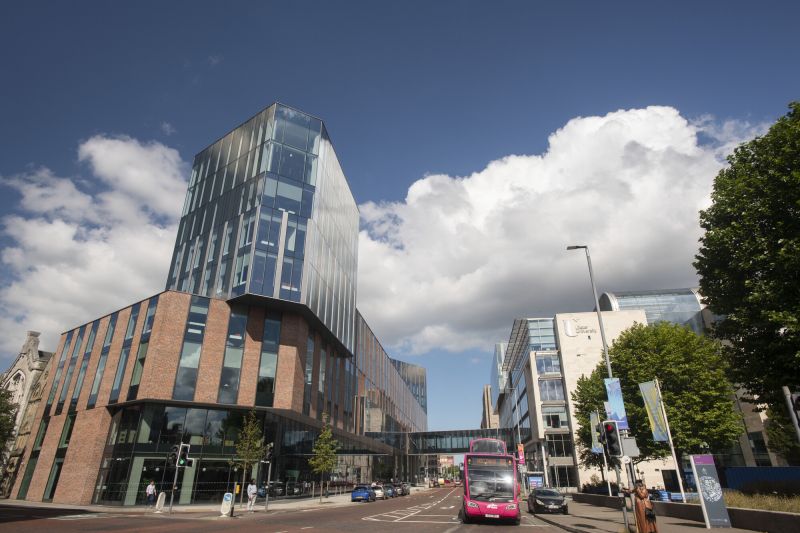
Art Unwrapped 2025 is our eighth annual ‘gift to the city’ exhibition aiming to bring to the widest possible public, rarely seen paintings from museum and private collections. This is your opportunity to have a free guided interpretive tour of a renowned artwork by Fine Art Students of Ulster University in an intimate gallery location on the new Ulster University Belfast campus.
The chosen artwork is presented as a “gift to the city” as well as the rest of Northern Ireland during the festive season. The event gives residents and visitors the chance to immerse themselves in the work of art and explore it in detail. For 2025, Art Unwrapped will explore 2 different works of art by T P Flanagan and his special connection with Seamus Heaney, marked by the display of the poem “Christmas Eve” by Heaney,
The works chosen for Art Unwrapped 2025 are
- Autumn Lough, 1961 and Weir on the Blackwater River, County Cork, 1993
- By Terence Philip Flanagan (1929-2011) from the collection of the Ulster Museum.
About the Artist
Terence Philip Flanagan, MBE, DFA (15 August 1929 – 22 February 2011) was a landscape painter and teacher from Northern Ireland.
Flanagan was born in Enniskillen, County Fermanagh and he attended Belfast College of Art from 1949 until 1953 . After his graduation, Flanagan taught at the Convent of the Sacred Heart of Mary in Lisburn and the Assumption Convent in Ballynahinch, County Down, before obtaining a full-time post at St. Mary's College of Education in 1955 where he stayed for 29 years until his retirement in 1984. He became Head of Art at St. Mary's in 1965.
By the 1960s, Flanagan had carved out a successful and parallel career as an artist, and his family became close to poet Seamus Heaney's family. Flanagan painted Boglands for Seamus Heaney in 1967 and, in response, Heaney wrote Bogland: for TP Flanagan published in the collection entitled Door into the Dark of 1969. Seamus Heaney, for whom he painted various pieces, described Flanagan as being in tune "with the notion of an earthly paradise and hence the radiance of the painting is entirely this-worldly”
Flanagan became only the second ever recipient of the honorary degree of Doctor of Fine Arts when he received the accolade from Ulster University 2010.
Flanagan died in Belfast in 2011, aged 81.
Tours
Eve McMullan
Tours
Konnie Morton
Piper Gross
Tours
Alannah McLaughlin
Student Presentation Scripts
Bastian Schwerer

The combined display of the paintings ‘Autumn Lough’ (1961) and ‘Weir on the Blackwater River, County Cork’ (1993) in this year's Art Unwrapped exhibition invites the viewer to reflect upon thirty years of change and development, as well as on the persistence of common threads, themes and painterly approaches in T.P. Flanagan's artistic exploration of the Irish countryside and landscape.
It therefore may be worthwhile to start an encounter with these works through an initial consideration of the relationships between time and change.
Today, Flanagan is regarded one of the most prolific and important Irish landscape painters of the latter half of the twentieth century. From 1960 onwards, his practice - and with it his relationship and interaction with the natural environments surrounding him - was often characterized by a serialized and reiterative approach to engaging with very specific locations.
Initially developing these methods in his paintings around the location of Lissadell in County Sligo, ‘Autumn Lough’ painted shortly afterwards in 1961 is part of a larger body of work focusing on Lough Erne in County Fermanagh.
By 1993, Flanagan was still utilizing this rather time-consuming method of examining, portraying and re-examining various aspects and fragmentary parts of landmarks, under different weather and lighting conditions. Such an approach is typified in his works on the Blackwater River in County Cork, thereby capturing ephemeral traces of an ever-changing interplay between viewer, landscape and light.
A thirty-year span stretching between these two paintings encompasses a large part of Flanagan's career and creative output. ‘Autumn Lough’ was once part of Flanagan's second ever solo exhibition at CEMA Belfast, whereas our second piece presents us with a painting from the artist’s late body of work. At the same time his subjects of landscapes and ecosystems operate on differing timescales. Without the violent intervention of industry, development and human interference, nature can remain unchanged for eons; yet at the same time, it is always shifting, pulsating with life and may appear almost intangible to our fleeting human perception.
Seamus Heaney, who incidentally introduced Flanagan to the method of working and engaging with specific locations in a serialized manner, also presents us with the image of the Irish boglands within different timescales: on the one hand, witnesses of Ireland’s history, cultural tradition and struggle for national autonomy, on the other hand silent observers of long gone centuries and millennia.
Now in 2025, almost another 30 years after the initial creation of the Blackwater painting, we as viewers are tasked with encountering, engaging with and relating to these works. Merely decoding or deciphering them seems to me a far too reductive description of the complex relationships and interdependencies Flanagan presents us with between his paintings, us as viewers, as well as the natural world we inhabit.
When thinking about time and Flanagan’s paintings, I catch myself repeatedly coming back to the famous James Turrel quote: “All art is contemporary art because it had to be made when it was now.”
The way Flanagan uses his gestural, almost abstract (yet precise) brushwork in capturing light, piercing through cloud formations or reflecting off calm as well as turbulent bodies of water, places his landscapes somewhere in the hybrid zone between memory and snapshot imagery.
In all cases they convey to the viewer actual lived experience, a body at some point in time, immersed and situated in an environment, remembering it and also enabling the viewer to (re-)experience it.
Yet I am also reminded of my own, and maybe our collective perspective on the work as inherently situated and solidified as an inhabitance of the present - all art being contemporary because when I looked at it, it was now.
Therefore, I find it difficult to think about the renderings of Blackwater River or Lough Erne without also reflecting upon decades of discourse surrounding the age of the Anthropocene and the never-before-seen terraforming of the earth, its landscapes and its geologic features.
Neither can I think about them without being reminded of contemporary discourses in the arts around the post-human, non-human-agencies and inter-species-kinships that were once popularized by philosophers like Donna Haraway and Bruno Latour.
These associations also do not seem too far-fetched, considering that Flanagan himself often spoke of his painting process as a relational connection with his environment, its natural illumination and his subject matter at large. He explicitly described light, for example, as an agent in and of itself capable of both defining forms but also abstracting and fragmenting them. His aim was to both convey his immediate personal reactions to and impressions of a place or location while at the same time honoring and respecting the natural shapes and phenomena he encountered. Keeping this approach in mind can thereby also be a way to situate Flanagan’s painting style in a space where abstraction and representation collide and where places and locations are simultaneously depicted, constructed and yet also obscured.
Both Autumn Lough and Weir on the Blackwater River, just as Heaney’s ideas on the boglands described earlier, are at the same time not only interested in the Irish landscape as environmentalist motives but can also be read through the lens of a desire for place and belonging in a political sense.
Flanagan's works thus offer a distinctly Irish perspective, with an interest in (re-)inventing and developing a visual language and a way of approaching the Northern-Irish landscape that surrounded him during times of political conflict. This can be illustrated through his consistency in continuously exploring the Irish countryside in his practice even though the genre of landscape painting was largely being neglected by other international artistic movements at the time like the Abstract Expressionists or Conceptual Artists.
Autumn Lough and Blackwater River therefore raise not only questions about how a relational perspective can transform our encounter with ecosystems, but also how our self-perception, our sense of place and our conception of home are shaped and determined by our environment. One could furthermore look to the French thinker Gaston Bachelard who also relates to these ideas with his poignant thesis: ‘I am the space where I am.’
In the end, Flanagan presents us with changing, fluctuating and pulsating sceneries and it is now our turn as contemporary onlookers living in unpredictable and sometimes bleak times to navigate uncertainty and ambiguity and to build meaningful connections. Maybe engaging with the perspectives and artworks Flanagan constructs and presents to us can be a first steppingstone in doing so. In my opinion, they seem at the very least as relevant as ever in the times we find ourselves in.
Síofra McCarthy
‘I cannot be weaned/ Off the earth’s long contour, her river veins.’ – Seamus Heaney, Antaeus.
T.P. Flanagan was born in 1929, into environments that fed his hunger for elaborate landscapes and energetic atmospheres. Growing up in County Fermanagh, with frequent visits to Sligo, he was constantly enveloped and enthralled by nature. He devoured the beauty surrounding him, capturing it with a curious eye and deft hand.
This talent and thoughtfulness were nurtured in art classes attended at Enniskillen Technical College, where he was taught watercolour techniques by the locally renowned Kathleen Bridle. As he grew so did his spirit for adventure, and he found himself travelling the country in search of new sites, approaching each area with excitement and energy.
T.P Flanagan lived through his brush, writing in a letter to John Hewitt: ‘Sometimes when one lifts a brush a feeling of certainty flows down the wood into the bristles.’
Despite studying and working in Belfast, Flanagan was forever connected to his birthplace of Enniskillen and continued to return and produce art linked to its scenery. One such scene was Lough Erne, a serene yet stunning lake which was central to many of his works.
‘Autumn Lough’ painted in 1961, and exhibited and purchased by the Ulster Museum in 1962, features this lake. For this painting Flanagan pared back his paint usage and leaned into abstraction. The result was an almost cubist quality, lying somewhere between the techniques of William Scott and Basil Blackshaw, both of whom he had worked closely with, and who were experimenting with new stylistic approaches at the time.
The colour of this work is significant. The palette is limited, including whites, greys and blacks, with touches of blue and orange. These monochromatic colours allow the viewer to focus on the texture and shape provided by the painter. Flanagan also borrows a large amount of colour from the board he painted on.
I really admire this decision as I believe it challenges the viewer to spend time fully comprehending and considering the piece - all the different aspects aren’t handed to us, we must break it down and then put it back together ourselves.
We have to pull the brown from the background, to place puzzle pieces of the picture together, until they have built a world around us, and we find ourselves entranced by the atmosphere of the painting.
The composition can be considered in two halves, as it splits horizontally in the shadow of the dark band across the middle. The top, busier half, aids a solidity to the landscape through the man-made architectural bridge. While the eye is drawn to the tonality of this and the luminosity of the sun, it then slowly skims downward to the bottom half. This half is entirely water. It is made all the more still in its contrast of the highly decorated top half. The water is calm, reflective, as pensive as the person viewing it.
About 32 years later, in 1992 and 1993, Flanagan made a series of paintings along the Blackwater River in County Cork, at the invitation of farmer and businessman Paddy O’Keefe. It was at this time that he painted out second painting, ‘Weir on the River Blackwater, Co. Cork.’ The landscape of Cork was new to Flanagan, and he approached it with a fresh energy.
The colour in this painting, like ‘Autumn Lough’ is fairly close to monochromatic, however this palette offers variations of blues, greens and browns. The colour palette can afford to be subdued as the texture and brushstrokes provide enough content to the painting. And indeed, these features draw in the viewer. Each brushstroke is filled with a vibrant movement and intense energy.
This combines with the high horizon to make the river appear louder and fuller. It seems to overwhelm and surround the viewer. In the foreground a rock breaks through, coming to a point halfway up the painting, dragging the eye inward. The rock offers a contrasting solidity to the water.
Its off-centre placement aids to the uneven portioning of the painting, giving it a more organic, wild feeling. The flat plane of the weir gives way to the rippling currents and downfall of the river. These abstract elusive lines allow energy to ‘flow’ seamlessly through the piece, until the eye is doing laps, following the strokes downward to the corner then across the bottom and up again to the trees.
It places the viewer into a kind of whirlpool until we ourselves feel as if we are flowing, a part of the river.
The composition thrusts the viewer into the centre of the river, and being so immersed the message of the painting makes it difficult to understand. The viewer must step back to decode the painting’s substance; what is it? In fact, one is so far inside the composition that the subject, the river, often only becomes apparent upon reading the title.
It is evident in this painting how Flanagan’s practice progressed and matured over the years. His paintings become less structural, his technique now swirling and surging with confident brushstrokes. He explored different levels of abstraction and found what worked for him and his work. The pared back reserved techniques of his youth have evolved into fluid experienced forms of expression.
T.P Flanagan was to receive an honorary degree of Doctor of Fine Arts from Ulster University in 2010, in recognition for his outstanding services to art. He continued to paint and exhibit until his death in 2011. His oeuvre has influenced many artists and will go on to inspire even more.
Throughout his life, Flanagan found beauty in the world and translated this energy through the bristles of his brush.
T.P. Flanagan lived through a paintbrush. He lived through light. He lived through landscape. He lived through autumn lakes and rushing rivers. As he observed the world, the iridescent Irish landscape shimmering under sunlight, through his paintbrush, through each stroke, each shape; T.P. Flanagan truly lived.
Alannah McLaughlin
T.P Flanagan is a remarkably focused talent and an exceptional one at that. When thinking of ways to describe the works of T.P Flanagan, I thought a lot about how his paintings make me feel.
When I see his paintings I feel calm and centred, almost as if I am seeing a certain personal story or memory from his lifetime. This magnetic force he creates with his paintings eminates from his talent for storytelling through the art of paint. Every gentle thoughtful stroke he places is done with so much care, in order for him to convey a certain moment in time.
You can feel all the emotions in “Autumn Lough” simply by the use of his colour palette. Similarly we can understand the undeniable magnetic energy that he employs within his painting “Weir on the Blackwater River,County Cork.” They are both enchanting works and amazing examples of his dedication to the hidden beauty of Ireland.
Autumn Lough is a meditation on stillness. The soft subtle use of muted ochres, greys and pale blues suggest the tranquility of an autumn day. The warm, tender brown shades emulate the traditional Irish beauty of the countryside that at times we may miss, walk past or ignore.
He transforms the mundane into something enigmatic. Yet he never tries to romanticise or elevate the places he paints, instead he listens to what they are showing him, and that is the true beauty of “Autumn Lough”.
A tranquil beauty where there is no human life or man-made objects.
A tranquil beauty where there is no presence of human intervention. Even the structure-like band in the middle of the water appears to have arisen as a natural force, a natural part of the landscape.
This painting for me represents the distilled beauty of an autumnal landscape. Flanagan creates a realness to his work, its like a memory to me, I believe that is why he is so beloved and respected as an Irish artist.
In contrast we have “Weir on the Blackwater River, County Cork”. This painting was done thirty years after Autumn Lough, and to my eyes whilst it is a very different work they both share many similar stylistic features that frequent Flanagan's work.
This painting was completed in 1993 using oil on canvas. The River Blackwater is known for its beauty and historical significance, making it a fitting subject for Flanagan’s poetic approach. The weir, a low dam across the river, certainly adds a manmade rhythm to the composition.
Whilst the brushwork remains soft and contained, the presence of the weir creates a subtle tension between natural and manmade elements.
Ultimately, Flanagan’s landscapes are not about geography—they are about atmosphere. Autumn Lough and Weir on the Blackwater River are companions in this regard. One a sigh, the other a murmur. Through them, Flanagan brings us to see the world not ‘as it is’, but as it ‘feels’ in a moment of quiet reflection.
His art is not a window, it is a whisper, and over the thirty years between the two paintings, this whisper deepened into a voice of quiet mastery. I think that is the power of his art, which seems to want to emphasize a sort of storytelling through painting.
It's a very similar relationship to the one Seamus Heaney had with the landscape of Ireland and it definitely makes their friendship all the more telling. The brush of this painter and pen of this poet to me are very similar, and in a sense complement each other beautifully.
Through their work a pride and respect for our native land, and how they personally explore the beauty that it possesses, is communicated in such a powerful way. Heaney wrote in the foreword of the book “T.P. Flanagan, Painter of Light and Landscape”, these thoughtful words of sentiment on his good friend:
”Terry has also been very much a personal friend as well as an artistic presence, somebody with his own inimitable blend of humour and cultivation, one of those people who have the gift for bringing company to life and keeping the spirits high.”
Charlotte McBride
A soft day, secluded stillness surrounds the land. Time trapped between the mist and lapping waves. An autumn sky mirrored in the amber water. The muted, warm colours fitting its title; ‘Autumn Lough’, a 1961 painting by T.P. Flanagan.
Born in County Fermanagh in 1929, Flanagan was a prominent and distinctive Irish landscape artist. His art captures the importance of ‘mental association’ with a place and being inter-connected with nature. The immersive character of his work is crafted through tranquil reflection, inviting the viewer to be still with the art.
Thirty years after ‘Autumn Lough’, Flanagan painted a ‘Weir on Blackwater River, Co. Cork,’ the tone of which contrasts the former painting. A forceful power, breaking the river, engulfing a vast stretch of land. Fragmented reflections revealing the rocks underneath. A rising figure, with stone reaching for land against the current.
Lough Erne, rich grassland, and stretches of farmland, were Flanagan’s familiar landscapes in Fermanagh. Flanagan was the eldest of seven and grew up living in The Hollow, Enniskillen. As a child Flanagan visited his aunt Elizabeth in Sligo, who ran a needlework school at Lissadell House, and it was she who first encouraged him to paint. By the age of eleven, Flanagan was being taught by the artist Kathleen Bridle, alongside artist William Scott at the local Technical School.
Bridle was a distinguished watercolourist, and as a teacher she allowed her students to ‘find their own voice’. In 1949, Flanagan took up an English course at Queen’s University in Belfast, however despite his remaining love for literature and poetry, he then transferred his scholarship from Queen’s to attend the Belfast School of Art.
Here, through painting, Flanagan developed an interest in ‘stillness’ as subject matter. According to him an empty bowl, can be ‘full of stillness.’ In 1953, Flanagan graduated from the art college and turned to teaching. The following year, he started lecturing at St Mary’s College of Education where he remained for twenty-eight years, becoming Head of Art in 1965.
In 1960, novelist Micheal McLaverty, a colleague at St. Mary’s, introduced Flanagan to the poet Seamus Heaney. The two became close friends and influenced each other’s work. Heaney encouraged Flanagan to paint his Lissadell series, as it was a meaningful and nostalgic place for Flanagan. This representational series was largely executed in watercolours, in a limited palette.According to Heaney, “there was a constancy with which he worked, a steady progress in confidence and technique.” The estate at Lissadell ‘set the course’ for his career, combining reflection of place with emotional connection.
Together on the lough shores of Fermanagh or the boglands of Donegal they sought new themes. On a trip to Gortahork, in Donegal, Flanagan painted a piece for Heaney, ‘Boglands (for Seamus Heaney)’, 1967. This time was fruitful and both artists took inspiration from the same sources.
In turn, Heaney’s poem ‘Bogland’ from his book “Door into the Dark”, was dedicated to Flanagan. A short while before Flanagan’s death in 2011, he gifted Heaney a small acrylic painting of a bog, within which was reflected a piece of ‘unexpectedly blue sky.’
Concurrent with the Lissadell theme, Flanagan produced a series of Lough Erne paintings. Through this series Kenneth Jamison, former director of the Arts Council of Northern Ireland, believed that Flanagan “became more and more obsessed with the subtleties of refraction and reflection, with the interplay of sky and water, of light and luminosity.” His oil painting Autumn Lough 1961 illustrates these points, although it is more abstract than most of the other works.
The small Islands throughout lower Lough Erne, speckled with ruins of ancient monastic settlements, are the subject matter of the painting. Dark block-like forms dominate the centre of the composition, and besides a thin horizon in the background, the composition is bare. He uses a wash-like circular motioned brushstroke, evoking a mood of calmness or perhaps melancholy.
The semi-cubist simplification of forms and almost chromatic range of colours later became central to his work. In the rest of the series, for example Spring Lough 1963-4, the forms are much softer. Through these paintings, according to Flanagan, ‘I wanted to acknowledge a certain decorative quality that had begun to emerge as I worked at it, without sacrificing a feeling for the natural elements of water and light.’
In late 1961, Flanagan held his second solo exhibition at the CEMA gallery Belfast. Autumn Lough was purchased for the Ulster Museum collection by Keeper of Art, Anne Crookshank.
In the 80s, Flanagan retired from teaching, dedicating even more time to his painting. In 1993, Paddy O’Keefe, an Irish agriculture journalist, asked Flanagan to make paintings of his house and its surroundings on Blackwater River, Co. Cork.
It was Flanagan’s first visit to that part of the country, and from this emerged his Blackwater Theme. With his newfound emphasis on the act of painting and a new subject, these oil paintings felt more expressionist with thick calligraphic brushstrokes. The river crashes away from the weir, the verdant landscape surrounding reduced to simply form and colour. A web of reflections weave in and out, contrasting the flat brushstrokes of the formerly calm river.
The few details in the foreground allow a sense of spatial recession and the direction of the brushstrokes draws the eye up to where the river bends out of one’s view. Blues, olive greens and umber comprise the limited palette, allowing for emphasis on the dramatic brushwork. The painting’s drama is in stark contrast to the tranquillity of his earlier work.
In conclusion, Flanagan was a determined painter who, according to Heaney, inclined ‘to the lyric and the opulent.’ In the early 2000s, Flanagan was appointed a member of the Board of Governors and Guardians of the National Gallery of Ireland. In 2010 at the opening of his exhibition “Correspondences”, the University of Ulster bestowed on him an honorary Doctor of Fine Arts Degree. Flanagan died in 2011, his legacy prominent as a devoted painter with singular talent, and his landscapes centring on a deeply personal sense of place.
Sources
Irish Times
Kennedy, S. (2013). T.P. Flanagan Painter of Light and Landscape. Farnham: Lund Humphries.
Elise Henderson
Painting is often used as a physical representation of comfort and familiarity. A way to see into another’s soul, and find solace within the content. For many artists, their lives are purely devoted to their work, and they pour every ounce of their lived encounters into their art.
For T.P. Flanagan, this was undoubtedly his outlet - his way to allow others to relish in the beauty of his native country, Ireland. His atmospheric landscapes paint a picture of his childhood home and the nostalgia of the Irish countryside. Using various mediums, including oils and watercolors, Flanagan creates both rough and detailed pieces to depict his view of Ireland’s natural beauty.
Our first work, the 1961 oil painting on board, “Autumn Lough”, is an example of his unique painting style as he depicts a study of Lough Erne. It is in great contrast to our much later oil painting, “Weir on the Blackwater River”, a 1993 work on canvas which shows a bright, flowing landscape of the River Blackwater in County Cork.
Born in Enniskillen in 1929, Flanagan began his painting journey in his teenage years. Taught by renowned artists and teachers such as the Irish watercolorist Kathleen Bridle, Flanagan quickly found his interest and specialty in painting to be landscapes.
Author S.D. Kennedy points out that Flanagan's work was “a pragmatic rather than theoretical activity,” perhaps due to how he was taught when he was a younger artist. His admiration for Kathleen Bridle’s watercolours is evident within his own work - it is clear the artistic influence Bridle had on Flanagan’s Irish country landscapes.
His work reflects his passion for the natural beauty of the Irish landscape; however, it is also a prominent feature of his work- especially within “Autumn Lough” and “Weir on the Blackwater River”- that Flanagan works both thematically and experimentally. His work is the embodiment of the atmosphere he attempts to capture, rather than the content being depicted, which only adds to the mystery and intrigue of his paintings.
Warm. Distant. “Autumn Lough” is a landscape which draws you in completely. With its comforting hues and soft lines, Flanagan’s almost abstract take on this scene is indeed a change from his otherwise picturesque work.
Although square-like brush strokes and unfamiliar shapes may in other hands invite a rough and detached feeling to the landscape, in Flanagan’s hands these intentional additions and loose stylistic approach elevate the composition, turning it into a haze of soft light, capturing the atmosphere of a hazy autumn sky.
Former director of the Arts Council of Northern Ireland, Kenneth Jamison describes this scene as a “suspended flux of softened lightness, paired with a “close affinity of imperceptive elements and without precise definition.”
Indeed, the content within this landscape is a flow of colour and tone, rather than a detailed description of the scene itself. From the viewer’s distant view of the Lough, there is a presence of luminosity within this landscape- a brightness which is subdued and delicate. The soft blend of warm whites paired with the wooden board’s natural colour peeking through gives the painting an almost translucent effect, as though the comforting view is but a hazy, fleeting dream.
T.P. Flanagan dismissed the idea that artists should limit themselves to one style of practice. Throughout his career as a painter, Flanagan explored various styles - realistic, tonal impressionism, lyrical landscapes and, in some instances, mild abstraction - yet most of his work tended to circle back to one theme - Nature.
His 1993 oil painting “Weir on the Blackwater River” displays this fluctuation of style, when we compare it to “Autumn Lough”. Its breezy, cool toned, light atmosphere creates an inviting scene and allows the viewer to become a part of the painting, due to the viewpoint which Flanagan has created, and we, as viewers, are immersed in the landscape.
Flanagan had been practicing his craft for decades by the time he produced this painting in 1993, and so, being an established artist, it seems he truly embraced all of the natural elements and used his artistry to make the painting come to life with his skillful brushstrokes and expert use of colour.
Kenneth Jamison goes on to describe Flanagan's work as a “subtilty of refraction and reflection, with the interplay of the sky and water, of light and luminosity.”
This outlook on Flanagan’s art perfectly encapsulates this painting, and his brushwork makes the scene feel as though wind is coursing through the trees and creating ripples in the river - a naturally beautiful sight to behold.
During his career, Flanagan became close friends with the renowned Irish poet Seamus Heaney. Both men had a deep admiration for the other’s creative craft, and so Flanagan produced what is now part of his “Gortahork” Series, including the oil painting “Boglands”, dedicating it to the Irish poet.
In response, Heaney created the poem “Bogland” in dedication to the artist. Heaney spoke of Flanagan’s work as a “Fetch of water and air, their mutual flirtation, their eternal triangle with a moody light.”
This beautiful description of Flanagan’s work is not only heartwarming, it perfectly summarises the two paintings in our exhibition. The contrast within the watery, earthy scene of “Weir on the Blackwater River,” which is a breath of fresh air, so bright you could feel the breeze weaving through the air; and “Autumn Lough”, a moody blend of warmth and comforting hues - like a fire lit dimly on a cool autumn evening.
It is almost paradoxical in the way our two paintings work so well as a pair beside one another. Heaney goes on to express Flanagan’s artwork as having a - “notion of earthly paradise, hence the radiance of the painting” - insinuating an otherworldly atmosphere is in the forefront of the artist’s pieces.
Upon reflection, both “Autumn Lough” and “Weir on the Blackwater River” are two very contrasting paintings, in every sense of the word. Their opposing colour scheme, tonal qualities, style and atmosphere are what make these paintings so charming and inviting to observe when beside the other.
T.P. Flanagan’s artwork has been left as his legacy, and has fixed in place the beauty of Irish landscapes alongside his admiration of particular locations. Through his experimental use of style over the course of his career, Flanagan truly captures a unique and beautiful atmosphere within his paintings, a skill which we as viewers can only deeply admire and appreciate.
Eve McMullan
“Between my finger and my thumb, the squat pen rests; snug as a gun.”
In ‘Digging’, Seamus Heaney compares his passion for composing poetry with his father’s labour working in the fields. T.P. Flanagan’s paintings, Autumn Lough, and Weir on the River Blackwater explore an intimacy with the land and history similar to that of Heaney's father ‘digging’ into the rich Irish soil.
T.P. Flanagan was a Northern Irish artist, born in Enniskillen in 1929. He went on to attend the Belfast College of Art in 1949. Before this he had been well prepared for his further education under the guidance of Kathleen Bridle at Enniskillen Technical College.
From his studies in Enniskillen, he became comfortable with the reduced palette and form that was becoming common amongst modern British painters at the time. Moving forward in his career, Flanagan became a lecturer at St. Mary’s College in Belfast, where he met Seamus Heaney, someone who would become a lifelong friend.
Seamus Heaney is a famous Northern Irish poet known for his vivid descriptions of Irish rural life and landscapes. Flanagan and Heaney both had an appreciation for the arts and the written word.
Heaney describes Flanagan in his own words as ‘romantic, even bohemian’. This romantic nature of Flanagan which Heaney speaks of, is evident within the nature which Flanagan paints from and speaks about, and is characterised by this devotion to the Irish landscape. He has been described as a sensual painter, ‘feeling though’ the landscape as he paints it.
Flanagan's paintings are mainly oil, but this is not the only media he worked with. Both oil and watercolour became familiar to him, probably an influence from his time under Katheleen Bridle who also used watercolour. In his curation of an exhibition in 1980 for the Ulster Museum in Belfast, he selected a painting by his former teacher, this work being the only watercolour in the show, entitled “Lough Erne from Rossfad”.
It is interesting to note that all of the works in the Ulster Museum show were landscapes, much like the two we are presenting here in Art Unwrapped. Of romanticism, Flanagan said he liked the romantic dark mountains in Daniel O’Neill’s “Knockalla Hills”. He also talked of JB Yeats' painting “Riverside Long Ago” as being unashamedly romantic, and he made literary associations with it too, representing nostalgic half-forgotten times.
Flanagan’s paintings here in Art Unwrapped, ‘Weir on the River Blackwater, County Cork’ and ‘Autumn Lough’ were created with a 32-year gap between them. Both are depictions of landscapes within the island of Ireland. T. P. Flanagan had a deep connection to the land, something he shared with his friend Seamus Heaney. Heaney tried to form depictions of the Irish landscape through words, whereas Flanagan uses painting.
Flanagan’s two paintings, Autumn Lough, and Weir on the River Blackwater, may at first glance look very different, even possible for some to believe they may not have even been created by the same artist, but upon further inspection, there are a few more similarities than one might think.
Let’s look firstly at ‘Weir on the River Blackwater’. Flanagan invites the viewer inside the scene - we are placed right into the action of the water flooding out. In this painting, he doesn’t need structure or stability; he has let himself feel the strength, energy and power of the water; he finds glory in the light and colour of the water. He’s enjoying it. Notice how the colour of the frame works with the tones in the painting, but without taking anything away from the painting itself. The canvas used adds texture to the piece, with the weave and grain showing through. This painting has a significantly more textured surface compared to ‘Autumn Lough’.
So let’s look now at this painting: the perspective in ‘Autumn Lough’ is more from ground-level. The way Flanagan has painted the middle band of the painting gives it a flat and abstract form, and here we can make connections with the paintings of William Scott.
Scott was one of the first British abstract painters. Scott and Flanagan were both from Enniskillen. Flanagan would have also been quite familiar with the abstracted works of earlier modern painters such as Cezanne whilst at Enniskillen College, such painters had been brought to his attention by the artist and critic Rodger Fry.
Upon viewing later American abstract artists, painters such as Scott and Flanagan realised they belonged more to the European tradition. This painting has a tone of abstractedness, but is still in-keeping with the direction that British painting was taking at this time. In this painting of ‘Autumn Lough’, the viewer is embedded in a landscape looking down at a distance from the horizon line; it is possible he exaggerated this so he could enjoy the water by abstracting it.
So both paintings have this connection to water. In ‘Weir on the River Blackwater’, the water is more fluid, whereas in ‘Autumn Lough’, it has more of a stillness. During the time between the 60s and 90s when these were painted, painters had often worked on hardboard as a painting surface instead of canvas.
Flanagan incorporated the hardboard used to paint ‘Autumn Lough’ in the painting by working with the colour of the hardboard to create an overall brown tone within the painting. Using translucent layers of white and mixing up colour on his palette which is close to the colour of the hardboard itself, he exaggerated the shades in parts, creating an orange-like Autumn colour. It is therefore very possible that he had been inspired by the time of year, and wanted to capture the light and colours of the season.
Ewan Burns
The latter half of the twentieth century is decorated with artists exploring new movements both on a global scale and localised within Northern Ireland. These developments in abstraction and reduction are showcased and challenged in many of Terence Philip Flanagan’s works throughout the long breadth of his career.
Enniskillen born, T.P Flanagan’s work is deeply rooted in his origins, not only due to his deep engagement with the subject of interconnections and history of the land, but also by virtue of those connections leading to his contemporaries.
Key figures included Enniskillen based teacher Kathleen Bridle who formed an initial artistic relation to the landscape; fellow pupil William Scott who was to lean even further into abstraction than Flanagan, hence mirroring and contrasting with him in this way; and close friend and poet Seamus Heaney, who collaborated with Flanagan in exploring and developing the relationship between the provenance and alteration of a place, captured in memory.
Personal history and intuitive memory are foundational to the substance and contextualisation of Flanagan’s work. This is highlighted by the sheer breadth of artistic style Flanagan has explored throughout his life, both in terms of physical qualities of paint and they manner in which they are used.
Our first painting, T.P. Flanagan’s Autumn Lough, is an example of his early career, and is emblematic of the concerns he had as to the reception of this style of work. A clear disambiguation of abstraction, in so much as it touches on some of William Scott’s concerns without abandoning the pictorial all together,this work maintains a clear sense of watery haze, and seasonal colours, aided by the wooden board upon which it was painted – see how the colour of the board itself is used to complement the actual material colour of the paint.
This choice of material expresses two qualities of Flanagan’s work: as an artistic characteristic it highlights the sparing nature with which paint, as well as colour is used. The cold greys contrast the undertone of orange, perhaps also painted, but more prominently the board itself. This muted, minimal quality evokes Flanagan’s experience of using watercolour, ensuring that the individual history of the artist is sewn into the piece's fundamentals.
Secondly, the use of board, a cheap alternative to canvas, easily obtainable if rougher to work with, perhaps further highlights the subtle tonality of the piece, the simplicity. It is of note that this piece was exhibited in 1961, early in Flanagan’s professional career, and although perhaps presented nervously, it went on to be purchased by the Ulster Museum.
The composition of this piece is also important to note, not only the striking shapes and sweeps of paint, but the positioning of water, air, and far off hills. Those blocky separations and the amount of space they take up on the board, the mounted view it offers of a vastness of simple tone.
This is in contrast to our second painting by T.P. Flanagan, entitled Weir on the River Blackwater, Co. Cork , which was painted from 1992 to 1993 by a much more experienced Flanagan late in his career. Although by this time well known for his breadth of style, there is clearly a further mastery of the medium of oil which continues to connect with sensibilities learned from watercolours.
The strong use of material and colour, as well as brush work, shows expert control over the process involved in this piece's construction. The paint’s thick, rich texture gives way where Flanagan sees fit, colours of limited, rich hue, peeking out from behind one another. As for the application of paint, the shape and manner it is applied is controlled, the deviations of form and starkness of certain lines rewarded by continued viewing.
The depth and dynamicity of this piece cannot be understated, each brush mark contributes to the visualisation of the power behind this river, the sheer force of the land. Also of note, both to speak of the immersive energy of this piece and in bold contrast to Autumn Lough, the viewer is placed in a perspective ‘bending’ position where we seem to stand within the scene.
There are many other points of contrast between the two, aside from how they differ in their presentation of landscape and the individual's position in it. Notice the very different uses of paint, the differing scales of palette, the material they are painted upon. To reiterate, we can see in both works similarities, again, in Flanagan’s history with watercolour.
Even more fundamental than this perhaps, his own history, blending so that the contrasting details show a greater whole. ‘Autumn Lough’ is in actuality Lough Erne, Enniskillen, a place of Flanagan’s youth. And although ‘Weir on the River Blackwater, Co. Cork’ was an area unfamiliar to him to begin with, this series of paintings that were born of his time in foreign fields was approached with a renewed vigour.
In this way, T.P. Flanagan’s career reveals not only a personal history, but a joint history, shared by many, and with the land itself. Simultaneously resplendent and intimate in its beauty.
Konnie Morton
T.P. Flanagan, also known as Terrence Philip Flanagan, was a landscape painter and teacher from Enniskillen, Northern Ireland. Flanagan was regarded as one of the most accomplished landscapists in Ireland in the second half of the twentieth century and in the early years of the twenty- first century.
Flanagan was a cerebral painter. He was not interested in the expressionist flourish of instant reaction; rather his manner was circumspect, reflective, the inner secrets of his paintings not easily yielded. Things were thoroughly envisioned before being committed to his surface.
Seamus Heaney, Flanagan’s lifelong friend quotes he had “been faithful to the ancient artistic impulse which is to bear witness to the wonder of the world and give glory to it, to make it firm by giving it form”.
Our first work, T.P Flanagan’s painting “Autumn Lough,1961” was created using oils. It was during this period that Flanagan completed several oil and watercolour paintings of loughs around Northern Ireland – such as a pair of paintings of Lough Erne from different perspectives. One from Bundoran Road and one from Carrickrea.
At the end of 1961 Flanagan held his second one-man exhibition, at the CEMA gallery in Chichester Street, Belfast. From the exhibition Anne Crookshank acquired his “Autumn Lough”, considered the foremost of his Lough Erne series.
In this painting his range of colours is almost monochromatic, the simplification of forms semi-cubist, and the intense concentration on the mood of the landscape, although hinted at previously, it is a development that in time was to become central to his work in general.
If you view this painting up close you will notice that Flanagan has painted “Autumn Lough” on hardboard. I found this very interesting as the colour of the hardboard is allowed to show through the translucent white, revealing how the surface he worked on has played a big part in the final look of the painting.
Hardboard has a grain-less smooth surface on one side, which allows the paint to glide on easily. “Autumn Lough” is built up in subtle, tonal washes. The painting’s colour scheme, which is characterised by warm, neutral tones evokes a sense of peace and connection to the natural world. I find this study of his very immersive because of the use of light, creating an intense sense of atmosphere.
T.P. Flanagan’s good friend, Seamus Heaney, described him thus:
“As an artist, Flanagan has gone his own way, explored the Irish landscape and enhanced the Irish landscape, painting through the discovery and elaboration of an individual style, one that we now take so much for granted that we tend to forget that it had to be invented.”
In 1993, T.P. was invited to County Cork to paint pictures of the River Blackwater and in due course they became his “Blackwater Theme”. The invitation came from Paddy O’Keefe, a prominent Irish agriculturist and farming journalist, who asked him to make paintings of his house and country.
With a new subject to tackle and a new-found emphasis on how he would approach these paintings, his work now assumes a more abstract character, as can be seen to favourable effect in the second work we will discuss, “Weir on the Blackwater River, County Cork.”
When looking at Flanagan’s painting the first thing I noticed without context of the painting was the focal point of the rock as it helps the atmosphere without disrupting the overall harmony.
The river is seen in full spate as it breaks free of the weir and the surrounding landscape, which is recognizable thanks to the title of the painting.
T.P. depicts an emotional and psychological experience of the place. As quoted, he did not want to produce a representation of the land but rather an essence of the land. In this painting there is a subtle flattening of the picture plane and the range of colours - principally blues and olive-greens - verges on the monochromatic, the viewers’ attention being held by the drama of the brushwork.
Seeing both paintings side-by-side, it is important to consider the size difference between them. “Autumn Lough” is 29.7 x 62.6 cm while “Weir on the BlackWater River, Co. Cork” is scaled at 91.5 x 121.9cm.
This played a major part in how I engaged with each painting - smaller paintings invite the viewer to come up close; allowing for an intimate experience. On the other hand, a large-scale painting tends to create an immersive experience for the viewer. This approach is also used to help express the grandeur and power of nature.
To conclude, these paintings show the development of Flanagan’s landscapes over the years; while the tempo of his activities slowed, his range continued to expand with little interruption.
“You learned something about artistic life by going into his studio”, said Heaney, continuing: “You realized that as an artist all you have is your art and what you make of it”.
Piper Gross
The soft ghosting of fog over mountains as I hiked was my invitation to this landscape. The Irish landscape is characterized by land and water drifting together into a soft symbiosis. The moss, rich green with early morning fog, the sheep's wool capturing dew drops from clouds drifting over the heather hills.
These moments of land and water coming together characterize Flanagan’s art. His early childhood exploring the countryside of Counties Sligo and Fermanagh grounded him in the landscape, and the experience of it taught him everything to come in his paintings. His memories and sense of place inform his art.
Memory is the act of pulling an experience from the depths of your mind. It is inherently fluid and ephemeral, like the currents of bodies of water. Flanagan uses water to elicit memory. His memories of loughs caught in brown shades of autumn light or old salmon rivers rushing past, pull at us to follow them.
Flanagan often paints water by leaving the canvas, board or paper to show through, just as memory has patches and shallow pools. Water and memory become synonymous through their effortless fluidity.
A sense of place (hereafter referred to as place) speaks to the embodiment experienced by knowing something so deeply as to feel it becomes a part of you. Place is something you ground yourself in, something solid you return to over and over again. Flanagan’s work calls both memory and place together, drawing internal and external together as a holistic experience of the Irish countryside.
Through the window of the bus on the way to the trailhead, I could see the sea and the Mourne Mountains. The clouds hung low over the coast, brushing against the treeline blanketing the mountains' feet. The trail ran along Glen River as I hiked through oaks, birches, beeches, and pines. Passing by small waterfalls, I wondered how Flanagan would frame this landscape.
The rocks of Glen River are smooth from the current that has caressed them for centuries. Slipping in a marshy meadow, my footprints tracked behind me like brushstrokes on this muddy trail, to be forgotten after the next rain.
The brushstrokes of Flanagan’s Weir on the Blackwater River are disjointed, much like my footprints were. This combination brings a sense of illusion, of something almost being there. The sense that if you don't focus, it might drift away. Each part of the painting is abstracted. You can’t quite tell that the river is surrounded by trees, their leaves lost to the disjointed brushstrokes like the periphery of a memory, but looking at the whole of the painting, pulling the image back to you, and in turn being pulled in, the trees return through the fog to be recognized. The light on the water echoes the refraction that memory makes.
I hike d past the stone wall separating woodland from the heather slopes. Those hills were damp from the brush of clouds, but at the moment were lit by glances of sunlight. Sheep and cows grazed amongst the mauve, lavender, mahogany, ochre, umber, and sage of the hills.
I gazed up at Slieve Donard. She was hidden by the soft blue of low-hanging clouds reflecting the granite of her slopes. I felt my heart open with a profound love for this place. The mountains were welcoming me as I found a deep sense of place in their embrace.
Flanagan’s gentle, mellow, and grounded color palettes represent a deep knowledge of place. They illustrate how well the artist understood the interactions of light with the Irish landscape.
The rich greens of the woods surrounding the Blackwater River call to a knowing of the smell of their bark after rain.
Autumn Lough’s colors overlay each other, one bleeding to the next and creating an eternal cycle.
Flanagan’s cohesive color palettes and use of negative space build a sense of the place these paintings are grounded in. His understanding of the materiality of acrylic, watercolor, and translucent oil, and the brushstroke placement onto the canvas, speaks to his interactions with the land as he found places to paint.
Flanagan’s paintings, Weir on the Blackwater River and Autumn Lough, create a disillusionment of the binary of place and memory through their blending of land and water. The soft curls of fog overlaying the hills in Autumn Lough blend seamlessly in light gray hues. The spar of the weir in the Blackwater River is almost lost due to the energetic strokes of the baby blue river rushing past.
The Irish landscape holds these truths of water and land in its soft, mushroom bodies, holding moisture to long-dead and decomposing logs. I see this symbiosis of elements now in the moss between granite stones at the peak of Slieve Donard, reflecting sunlight with dew drops from the clouds just blown past.
Flanagan’s brilliance lies in his willingness to reject the boundaries of binaries and intertwine memory and place to represent the Irish countryside he learned so much from. I in turn have come to experience this landscape with new eyes through his paintings.