



Centre for Legal Technology
The Centre for Legal Technology (CLT) at Ulster University is leading innovation at the intersection of law and technology. We explore how emerging technologies can enhance legal practice, legal education and public services, with a clear commitment to improving access to justice and transforming how legal support is delivered.
An interdisciplinary initiative co-led by the School of Law and the School of Computing, Engineering and Intelligent Systems, the CLT brings together legal expertise and technological insight to develop practical, future-focused solutions for the legal sector.
About us

The Centre for Legal Technology exists to reimagine how legal services are delivered, harnessing emerging technology to widen access to justice, strengthen legal practice and education, and build a fairer, more efficient legal system for everyone.
A legal system in which technology removes barriers rather than creates them, where courts are digital and accessible, disputes can be resolved quickly and fairly, and the next generation of legal professionals is equipped to lead responsible innovation. We aspire to make Northern Ireland a recognised hub for legal technology and a model for how law and technology can serve the public good.
Access to justice comes first. Every project is measured against a single question: does this make justice more affordable, understandable and reachable for the people who need it? We are interdisciplinary by design, bringing law and computing together as equal partners in the belief that the best solutions emerge where legal expertise and technical insight meet. We pursue responsible innovation, advancing AI and emerging technologies with a clear commitment to ethics, transparency and the public interest, never treating innovation as an end in itself. Our work stays grounded in practice: we collaborate closely with law firms, government, the courts and industry so that our research and prototypes solve real problems in the real world. Above all, we are committed to empowering people, using hackathons, ideation labs and start-up pathways to give students and early-career professionals the tools, confidence and opportunity to shape the future of legal services.
Our Work
Our work spans a wide range of activities. We advance online dispute resolution and the digital transformation of courts, helping to make justice more efficient, accessible and fair for all. We support LegalTech innovation through research, education and industry engagement, and host hackathons and ideation labs that empower students and early-career professionals to co-design the future of legal services. We provide pathways for start-up development, from concept through to working prototypes, and conduct research into AI, ethics and regulatory technology, shaping how innovation can serve the public interest.
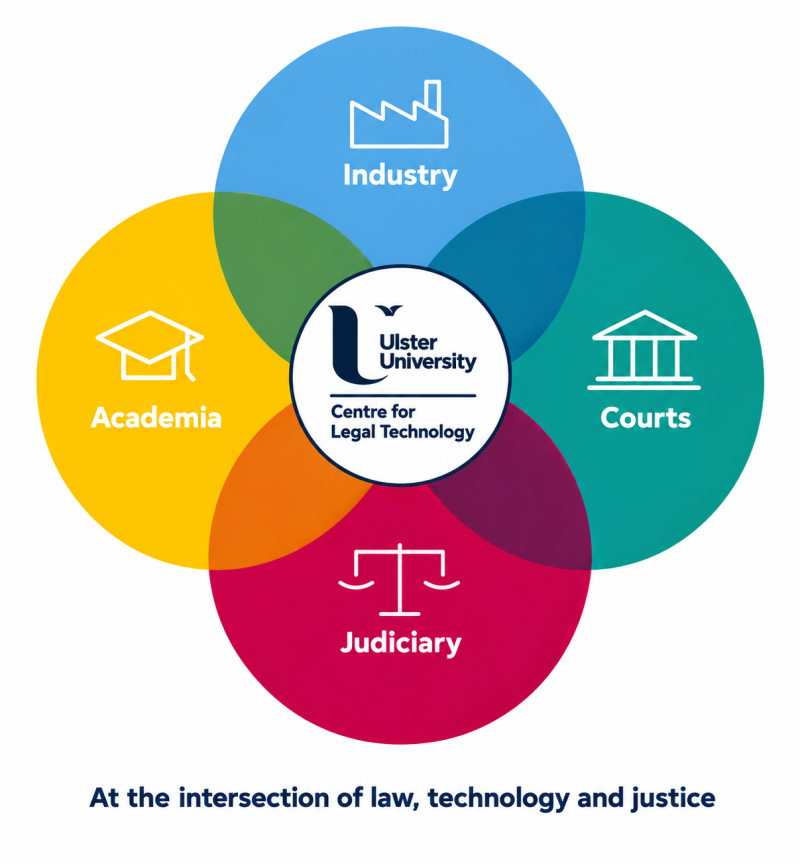
We work closely with law firms, government departments, technology providers and justice reform bodies to ensure that all of our initiatives are grounded in collaboration and real-world relevance.
Whether you are a student, researcher, policymaker or industry professional, the CLT offers opportunities to engage with and shape the evolving role of technology in law.
Since our launch, we have become a driving force in Northern Ireland's growing legal innovation ecosystem, and we are only getting started.
Projects
Learn more about our current research.

AI in Judicial Decision Making
Ulster University’s Centre for Legal Technology to lead research into the role of AI in judicial decision making

Collaboration Project, CLT, LRA and Talk Terms
AI Solutions for Mass Case Management Pilot

AI to Revolutionise Conveyancing Process as Centre for Legal Technology teams up with Lawri AI
AI to Revolutionise Conveyancing Process as Centre for Legal Technology teams up with Lawri AI A new research and innovation...

Legal AI Roadshow to Help Practitioners Harness Technology Responsibly
Ulster University’s Centre for Legal Technology (CLT) and the Law Society of Northern Ireland have joined forces to launch the...

Building Trust in Justice: Advancing Responsible AI in Legal Systems
Building Trust in Justice: Advancing Responsible AI in Legal Systems


Stay up to date



Staff Publications
Author: Adam Buick
Generative AI models rely heavily on copyrighted data, often used without permission. This has led to calls for transparency in AI training data, recently reflected in the EU’s AI Act. However, this paper argues that transparency alone cannot resolve the broader copyright challenges posed by generative AI. Its impact depends on existing legal frameworks, which may be inadequate—exemplified by the AI Act’s reliance on the flawed opt-out mechanism under the CDSM Directive. Thus, while necessary, transparency requirements are insufficient. Broader legal reforms are needed to balance innovation with rightsholder protection.
To view the full article, please follow the link below:
Copyright and AI training data - transparency to the rescue? - Ulster University
Staff Spotlight: Dr Adam Buick on AI Regulation in Northern Ireland
We’re proud to see Dr Adam Buick, law lecturer and researcher with the Centre for Legal Technology, featured in the latest MLex article examining the potential impact of the EU AI Act in Northern Ireland.
In the piece, Dr Buick explores how regulatory divergence could affect major UK government projects—particularly those using AI in sectors like healthcare. His contributions underscore the Centre’s active role in shaping AI policy and legal innovation.
As Northern Ireland navigates both UK and EU frameworks, our team remains committed to promoting ethical, clear, and forward-looking approaches to AI in justice.
To view the full article, please follow the link below:
Author: Chibuzor Udokwu, Vimal Dwivedi, Adam Buick, John Keers, Jun Liu
An agentic AI system could assist in reducing case workloads in the judiciary by providing a probable outcome for litigating parties and eliminating the need to go to court. However, agentic AI uses different ML and LLM models in its workflows, and these models may reflect biases present in their training data. These biases could affect the outcome of the pre-litigation proceedings, favouring one litigating party over the other, depending on demographic representations in the training dataset. We consider an Agentic AI marketplace where litigants can verify demographic representation in the training data of ML/LLM models used in each Agentic AI before selecting a suitable system for pre-trial analyses. ZKPs provide cryptographic primitives for verifying such claims without disclosing full information about the underlying dataset. This paper outlines a conceptual framework for performing these verifications within the European regulatory context. First, we demonstrate the implementation of an Agentic AI system for prelitigation analyses and then conceptualize an Agentic AI marketplace, outlining different technological interactions. We then formalise demographic representation as a verifiable property and outline a ZKP framework for verification, comprising different tech stacks like BBS+ signatures, bulletproofs, zk-SNARKs, and smart contract oracles. This paper presents a conceptual and architectural framework rather than an empirical system evaluation, and aims to establish a foundational design space for privacy-preserving bias verification in agentic legal AI.
To view the full article, please follow the link below:
Our People
If you have any queries or would like to learn more about the Centre, please contact CLT@ulster.ac.uk

Staff
Learn more about the Centre for Legal Technology staff.

Advisory Board
Learn more about our Advisory Board