

Sharing research data instils public trust, maximizes research value and reach, supports informed decision-making and acknowledges the value of research participants and partners.
Are you confident that sharing your data boosts your credibility, reputation and networks, or perhaps a little apprehensive about ownership, publication, control or interpretation? These are not uncommon considerations for researchers at any stage in their careers.
During the national Open Access Week (20-26 October), researchers are invited to think beyond legal factors to consider the ethics of control, access, and re-use of data. Not to mention the very tangible benefits to researchers themselves and wider civic impact.
Dr Loraine Hanna, Open Research Officer explains,
“Making research data open ensures that it is more readily visible, discoverable and valuable to all who might benefit from it. Open access research enables credit and recognition and can open doors to collaborations that could take future enquiry even further.
Increasingly, access to research data is a requirement of funders who advocate for and expect research findings to be for the public good with as few restrictions as possible.
For all these reasons, and in the best interests of researcher, communities, interested parties, partners and participants, open access research is a central platform of research culture and community at Ulster University.”
Researcher Experiences
Insight catches up with just some of our researchers who share their experiences, with useful links to get you thinking along similar lines about your research ownership, accessibility and impact.
- Reflecting the participant point of view
Dr Suzanne Beech, Senior Lecturer in Human (Economic) Geography.
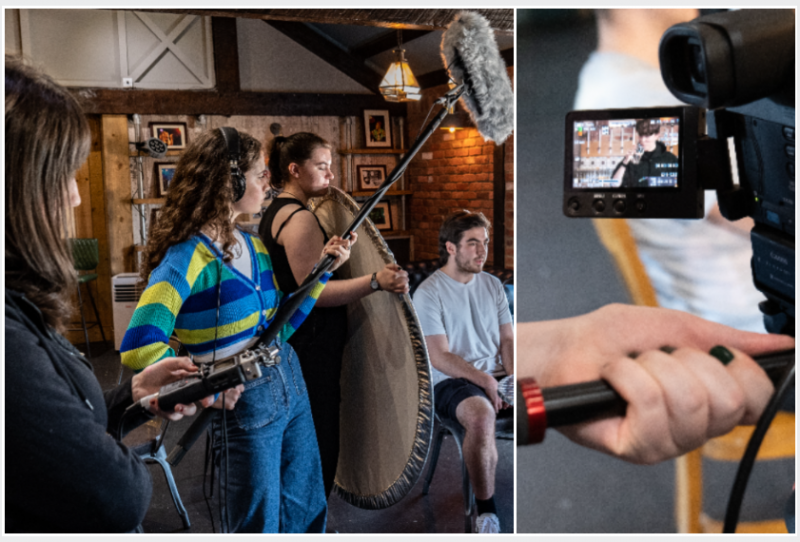
In recent years, Suzanne has uploaded several films to Ulster’s PURE Datasets, produced by the Nerve Centre in Derry~Londonderry, reflecting young people's understanding and experiences of the Irish Border as part of the Bordered Youth Project.
Suzanne explains:
“Being in receipt of public funding for my research it was always important to make sure it was shared as much as possible and freely available. Keeping our research in the public domain is one way to deliver more impact, with funding well spent making a difference.
Our partnership with the Nerve Centre delivered high quality films that best reflected the experiences of the young people involved. This research approach and inclusive creative process equipped the young people with skills in film making and production. They were incredibly proud of their work, and so it matters to us as researchers that we share that widely.
Our research aim was to provide a platform for young people's voices on a critical political issue - the future of the Irish border. An academic article, whilst also being openly available, can only be a researcher's voices interpreting what the young people had said. Freely available films offer a much greater and more authentic insight. As a project that was highly participatory, we were focused on the co-creation of knowledge with the young people whose voices and perspectives we captured, heard and shared.”
Hesitant about opening up and managing your data?
Read on and Register:
- Opening your data is easier than you think - addresses researcher concerns around open data and offers guidance for moving your open data journey forward.
- For more guidance on research data management see Resources for Researchers Research Data Management.
- Data Management Plans are a way of ensuring that researchers have thought about how to create, store, backup, share and preserve their data and are an increasingly common requirement for many funding proposals. REGISTER HERE for our webinar offering good practice pointers for researchers writing a Data Management Plan.
- Creating opportunities and making connections
Dr William Smyth, Senior Lecturer in Mathematics.
Researchers become more discoverable and visible when their work is openly available, enabling others to find them and their expertise and often leading to meaningful collaborative solutions that strengthen research outcomes, nurture trust and extend powerful research networks. It’s why Open Research is integral to a healthy research culture and environment.
Shifting the core question from “Who owns our knowledge?” to “how can we best steward it?”, reflects that while institutions may hold the legal rights, researchers have a responsibility and an opportunity to maximise its value through openness.
William’s presentation at Ulster University’s inaugural Open Research Week explored how sharing his knowledge led to a transformative collaboration with an economics Nobel Laureate.
William explains:
“Opening my research data allowed colleagues from outside my immediate field to engage with my work, which directly led to new collaborations that I could not have anticipated. Sharing openly helped to build trust, not only in the robustness of my results but also in my willingness to let others scrutinise, build on, and challenge them.
The most transformative outcome for me was that open data was the catalyst for a collaboration with a Nobel laureate in economics, something that would never have come about had I kept my work closed.
Opening my research data also gave me the opportunity to explain my work to people involved in Ireland’s premier impact investment fund, which fittingly has an open and transparent ethos, supporting the principle that impact investment should deliver profit with purpose. That emphasis on transparency resonates strongly with the spirit of my own research, where clarity and interpretability are key.”
Interested in open research practices but not sure where to start in your discipline?
- Examples of good practice and resources across disciplines (2025 edition) produced by the UK Reproducibility Network, provides examples of how open research is used in a wide range of disciplines and a list of resources ranging from research papers about open research to useful web links, handy how-to guides to details of relevant preprint repositories or open access journals.
- In case you missed it, catch up with other positive Ulster researcher experiences of open research through The value and rewards of Open and Responsible Research
Useful Links and contacts:
For the international conversation, visit INTERNATIONAL OPEN ACCESS WEEK
Your local Open Access contact: Open Research Officer, Dr Loraine Hanna by email to l.hanna@ulster.ac.uk
In case you missed it, catch up with the library’s Open Research Team on INSIGHT.