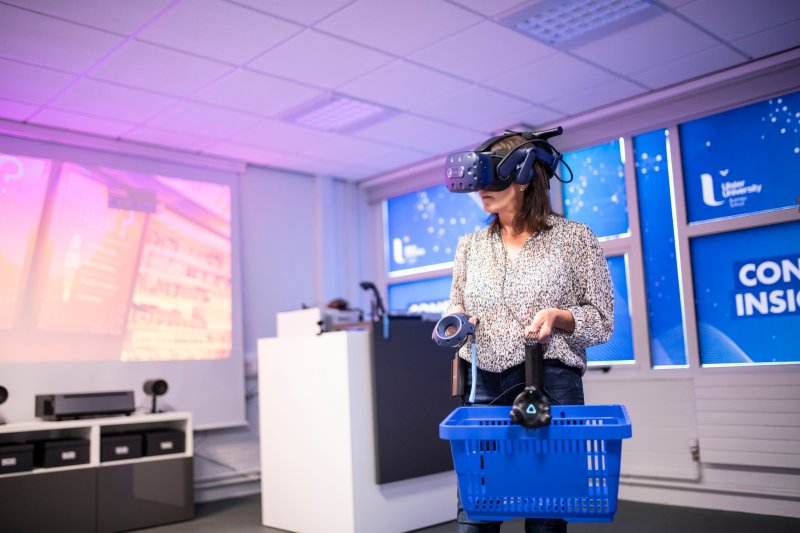




Kerri Grant is standing in the middle of a supermarket aisle, but not the kind you’d find on any high street.
Wearing a VR headset, she watches as shoppers navigate a virtual store, their gaze tracked in real time. Every flicker of attention, every moment of hesitation, every product picked up or ignored becomes a data point. For Grant, a researcher whose work sits at the crossroads of behavioural science and public health, those tiny decisions tell a much bigger story about how we shop.
Grant’s PhD project was an ambitious, multiphase investigation into a deceptively simple question: how can we make healthier food choices easier without restricting choice? Her focus is on dietary fibre, a vital nutrient that most people in the UK fail to consume in adequate amounts. Despite decades of public health messaging, fibre intake remains stubbornly low. Grant believes the problem isn’t a lack of information, but the way that information is presented in the places where choices are made.
Walk into any supermarket and you’ll be bombarded with claims: “high in protein”, “low in fat”, “source of fibre”. However, Grant’s research shows that these labels often fail to cut through the noise. Her market analysis reveals a landscape dominated by vague, simplistic fibre claims, formats that are easy for brands to use but not particularly helpful for consumers trying to understand what they’re buying.
“Consumers want clearer, more informative labels,” she explains. “The problem is that the labels we currently see on shelves don’t match what people actually want or need to make sense of fibre.”
To understand what really happens in the split second when someone reaches for a product, Grant goes beyond surveys and self‑report. Her project combines:
- Market data to understand how fibre is communicated
- A large-scale consumer survey to map attitudes and expectations
- A VR supermarket experiment that recreates the complexity of real shopping
- Eye‑tracking technology to capture attention and decision‑making moment by moment
This mixed‑method approach allows her to observe behaviour directly, what people look at, what they ignore, and how small changes in labelling influence their choices.
The results are striking. When fibre information is presented more clearly, shoppers are more likely to notice it, understand it, and choose higher‑fibre products. These aren’t dramatic interventions, just better communication.
Grant’s work sits firmly within the world of behavioural “nudges”: subtle design changes that guide people toward better choices without limiting freedom. In a retail environment where dozens of messages compete for attention, she argues that well‑designed cues can make a meaningful difference.
Her findings offer practical, evidence-based recommendations that policymakers, retailers, and food manufacturers can act on now. Clearer fibre labelling, she suggests, is a high impact opportunity hiding in plain sight.
Beyond its immediate implications, Grant’s project showcases the power of immersive, data‑driven research methods. VR supermarkets and eye‑tracking aren’t just flashy tools. They allow researchers to study real‑world decision‑making with unprecedented precision.
At its heart, Grant’s research is about fairness. Healthy choices shouldn’t require expert knowledge or superhuman willpower. They should be the easy choices for the consumer in their weekly shop.
By revealing the gap between what consumers need and what the market currently provides, Grant is helping to reshape how nutritional information is communicated. Her work suggests that with small, thoughtful changes, supermarkets could become powerful allies in improving public health.
And if her VR supermarket is any indication, the future of healthier eating might start with something as simple as a better label.