


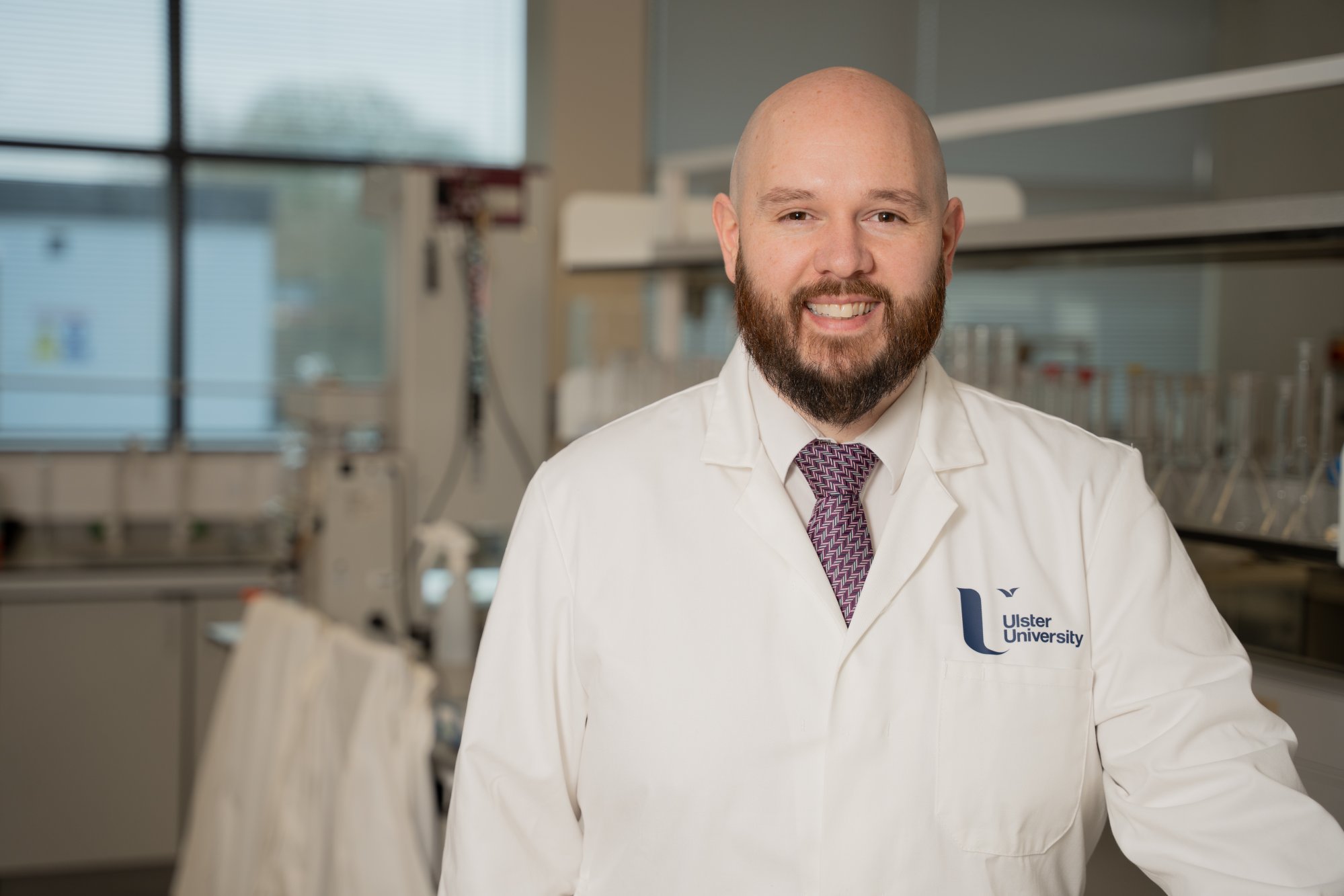
When Dr Aaron Courtenay works alongside healthcare teams in Ghana, Jordan, Indonesia, or Northern Ireland, the conversations are rarely just about medicines or diagnostics alone. They are about how health systems learn, adapt and respond under pressure.
As Senior Lecturer in Clinical Pharmacy at Ulster University and Co-Director of the Centre for International Health Innovation & Partnerships (CIHIP), Aaron’s work focuses on what he describes as “adaptive clinical systems” , approaches that connect diagnostics, medicines stewardship, workforce development, and implementation learning across different healthcare settings.
Rather than exporting solutions, his work is built around long-term partnership, shared expertise, and reciprocal learning between clinicians, researchers, policymakers, and healthcare organisations internationally. Across Europe, the Middle East, and Africa, these collaborations are helping shape new approaches to diagnostics, pharmacogenomics, antimicrobial stewardship, medicines optimisation, and healthcare education, while also influencing practice and learning within Northern Ireland itself.
One of Dr Courtenay’s major research interests focuses on minimally invasive diagnostic technologies designed to support earlier disease detection and more personalised care pathways. Through Epifluidix™, an emerging polymeric diagnostic platform, his work explores how biomarker and epigenomic signals may be captured using simple, patient-friendly approaches capable of integrating into future clinical systems.
The technology aims to support the identification of clinically relevant biomarkers linked to inflammatory disease and oral cancer, with early proof-of-concept studies demonstrating the feasibility of biomarker capture. However, for Dr Courtenay, the challenge is not simply developing a device in isolation.
“Diagnostics only create impact when they can integrate meaningfully into clinical systems, workflows, and decision-making, the question is not just whether technology works, but how health systems can adapt around it to improve patient care.”
This systems-focused perspective underpins much of his wider research and partnership activity. Alongside diagnostic innovation, Dr Courtenay’s work has a major focus on antimicrobial stewardship (AMS) and pharmacogenomic based medicines optimisation. Through the Centre for International Health Innovation and Partnership (CIHIP), he co-leads international collaborations examining how healthcare systems can respond to the growing global challenge of antimicrobial resistance while strengthening prescribing practice, education, and patient safety.
One major strand of this work has focused on partnership activity between Ulster University and Kwame Nkrumah University of Science and Technology (KNUST) in Ghana. Supported through successive Commonwealth Partnerships for Antimicrobial Stewardship (CwPAMS) programmes, the collaboration has brought together pharmacists, clinicians, academics, and healthcare leaders to co-develop stewardship education, implementation research, and prescribing initiatives.
The partnership has supported workforce development, new approaches to diagnostic and prescribing stewardship, and the recognition of KNUST University Hospital as an AMS Centre of Excellence. Importantly, the collaboration has also informed learning and research practice within Northern Ireland, reinforcing the value of international knowledge exchange in addressing shared healthcare challenges.
Dr Courtenay’s work extends across a growing network of global partnerships through CIHIP, which he co-directs with Dr Ahmed Abuelhana. These collaborations include the development of international PhD pathways, healthcare education partnerships, implementation research projects, and multidisciplinary innovation initiatives across the Middle East, Africa, Europe, and Southeast Asia.
The centre’s philosophy is centred on co-production, long-term relationship building, and sustainable partnership development. In practice, this means creating collaborative environments where expertise moves in multiple directions between institutions, professions, and healthcare systems.
For Dr Courtenay, this reciprocal approach is essential to addressing modern healthcare challenges.
“Some of the most important lessons in healthcare innovation come from understanding how different systems adapt under pressure. There is enormous value in learning across healthcare environments rather than assuming expertise moves only one way.”
Central to Dr Courtenay’s research is the idea that healthcare challenges cannot be solved through isolated interventions alone. Diagnostics, prescribing, workforce capability, implementation science, and digital innovation all interact dynamically within clinical environments. His work therefore focuses on understanding and strengthening adaptive clinical systems - systems capable of learning, responding, and evolving through partnership, evidence generation, and continuous exchange of expertise.
Whether through diagnostic innovation, antimicrobial stewardship, healthcare education, or international partnership development, the aim is consistent: creating adaptive clinical systems capable of learning, responding, and evolving across diverse healthcare environments.